Workers compensation insurance is not optional for most employers. It is a legal requirement in virtually every U.S. state for businesses with employees, and the penalties for operating without required coverage are severe including personal liability for injured employees' claims, substantial regulatory fines, and in some states criminal prosecution of responsible business owners. Beyond the legal obligation, workers compensation represents a fundamental protection for the most valuable assets in most businesses: the people who do the work that generates the revenue.
This guide explains how workers compensation insurance works, what it costs across different industries and states, how the experience modification rating system ties your premium directly to your safety record, and the specific strategies that help employers maintain competitive premiums while meeting their legal obligations and genuinely caring for their workforce.
In This Article
- What Workers Compensation Covers
- Who Is Required to Have Workers Comp
- How Workers Compensation Is Priced
- Classification Codes and Why They Matter
- The Experience Modification Rate
- What Workers Comp Costs by Industry in 2026
- State Funds vs Private Insurance
- How to Reduce Your Workers Comp Costs
- Managing Injuries and Claims Effectively
- Who Is Not Covered
What Workers Compensation Insurance Covers
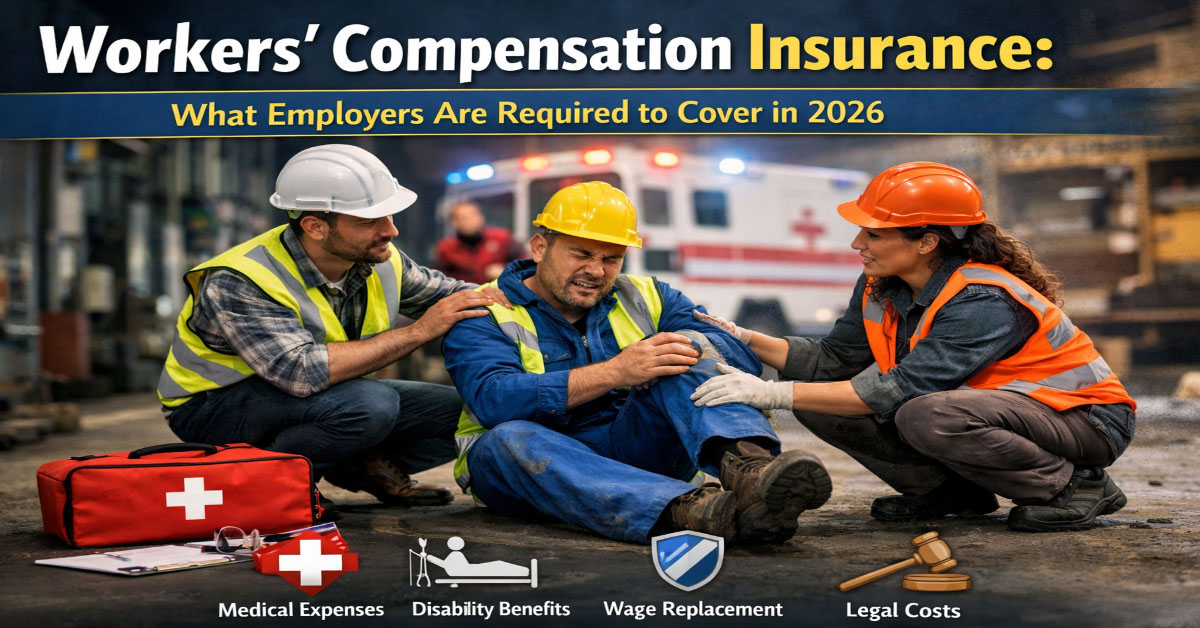
Workers compensation insurance provides five categories of benefits to employees who are injured in work-related accidents or develop occupational illnesses in the course of their employment. Medical benefits cover all necessary and reasonable medical treatment for a work-related injury or illness with no deductible, copayment, or coverage limit imposed on the injured worker. This includes emergency treatment, hospitalization, surgery, physical therapy, prescription medications, and necessary medical equipment related to the work injury, for as long as medically necessary according to the treating physician and applicable state guidelines.
Temporary disability benefits replace a portion of an injured worker's wages during the period they cannot work due to a covered injury. The replacement rate is typically 60 to 70 percent of the worker's average weekly wage, subject to state-specific minimum and maximum benefit amounts. Benefits continue until the worker is able to return to work or reaches maximum medical improvement as determined by a treating physician under the applicable state workers compensation medical guidelines.
Permanent disability benefits compensate workers who sustain permanent physical impairments from a work injury that affect their long-term earning capacity. The benefit amount and duration depend on the severity of the impairment as rated under the state's disability rating system. Vocational rehabilitation benefits provide retraining and job placement assistance for workers who cannot return to their pre-injury occupation due to their injury's permanent effects. Death benefits provide weekly income payments to surviving dependents and a burial allowance when a work-related injury or illness results in the employee's death. Workers compensation also includes employers liability coverage that protects the business against lawsuits by injured employees or their family members that fall outside the workers compensation exclusive remedy framework in specific circumstances.
Who Is Required to Have Workers Comp
Workers compensation requirements vary by state but virtually every state requires employers to carry coverage once they have one or more employees. Some states require coverage with the first employee. Others set a threshold of two, three, or four employees before coverage becomes mandatory. Texas is the notable exception, being the only state where workers compensation is entirely voluntary for most private employers, though employers who opt out face unlimited common law tort liability for employee injuries rather than the limited liability that the workers compensation exclusive remedy provides.
Coverage requirements typically extend to part-time, seasonal, and temporary employees as well as full-time employees. Independent contractors are generally not employees for workers compensation purposes if they are genuinely independent, meaning they control how they perform their work, supply their own tools, work for multiple clients, and bear the financial risks of their business. However, misclassifying employees as independent contractors to avoid workers compensation obligations exposes employers to significant liability including back premiums, penalties, and personal liability for injured workers' claims during the misclassification period. Many states actively audit worker classification and impose meaningful financial consequences for misclassification.
The consequences of operating without required workers compensation coverage are severe. An injured employee can sue the employer directly for the full amount of their medical costs, lost wages, and pain and suffering without the liability limitations that the workers compensation system provides through the exclusive remedy doctrine. State labor departments impose fines for uninsured periods, sometimes calculated per day of uninsured operation. In some states, the business owner or responsible officers can be held personally liable for any employee injuries that occur during an uninsured period regardless of the business's corporate structure.
How Workers Compensation Insurance Is Priced
Workers compensation premiums are calculated by applying a rate to the employer's payroll, adjusted for the specific occupational classifications of those employees and the employer's individual claims history over the past three policy years. The formula is: payroll divided by 100, multiplied by the applicable rate per $100 of payroll for each classification code, multiplied by the experience modification factor, multiplied by any applicable schedule or merit credits or debits approved by the rating bureau. Understanding each component of this formula allows employers to identify where premium management opportunities exist and take targeted action.
The rate per $100 of payroll is established by state regulatory bodies and reflects the average historical workers compensation cost for that occupational class across all employers in that classification. A higher-hazard classification like roofing or structural steel work carries a much higher rate than a lower-hazard classification like clerical office work. The rates are set at the industry and classification level based on aggregate loss data and are updated periodically by the rating bureau to reflect changes in actual claim costs for that class.
Classification Codes and Why They Matter
National Council on Compensation Insurance classification codes describe specific occupational activities and their associated risk levels. Each employee in your business should be assigned to the classification code that most accurately describes their primary job duties. An employee who primarily performs clerical work should be classified in the clerical classification, not in the production or field operations classification, even if they occasionally visit field sites for monitoring purposes. An employee who primarily performs a lower-hazard task should not be classified in a higher-hazard classification simply because their supervisor has broader duties that include some high-hazard work.
Accurately classifying employees is both a legal requirement and a significant premium management opportunity. Overly broad classification of employees in higher-hazard codes than their actual work warrants is a common source of overpaying for workers compensation. Carriers conduct premium audits at policy year end to verify that the payroll and classifications reported accurately reflect what actually occurred during the year. If an audit reveals that employees were misclassified in lower-rate codes, additional premium will be assessed. If an audit reveals that coverage was overpaid due to over-classification, a premium credit will be issued.
The Experience Modification Rate: How Your Claims History Directly Affects Premium
The experience modification rate, universally called the E-mod, is the most powerful factor affecting workers compensation premium for established businesses and the factor that most directly rewards safe workplace practices with lower costs. The E-mod compares your actual workers compensation claims costs over the past three policy years to the expected claims costs for a business of your size and industry classification. An E-mod of 1.0 means your actual experience exactly matches the expected experience for your class. An E-mod above 1.0 means your actual claims costs exceed the expected level, and your premium is surcharged accordingly. An E-mod below 1.0 means your claims costs are better than expected, and you receive a premium credit that directly reduces your annual premium.
The financial impact of the E-mod is direct and significant. A business with a $50,000 annual workers compensation premium before modification will pay $60,000 with an E-mod of 1.2 and $40,000 with an E-mod of 0.8. Over a five-year period, the difference between a 1.2 E-mod and a 0.8 E-mod represents $100,000 in cumulative premium differential on that base premium level. Large businesses with significant payroll can have E-mod impact measured in hundreds of thousands of dollars annually, making safety investment among the highest-return operational decisions available to the business.
The E-mod is calculated by NCCI or the applicable state rating bureau based on submitted claims data and is typically updated annually. A single large claim can affect the E-mod for three to four policy years before it rolls off the experience period. Multiple claims compound the effect dramatically. A business that goes three consecutive years with zero or minimal claims can achieve a very favorable E-mod that provides a meaningful competitive cost advantage over competitors in the same industry with less favorable safety records.
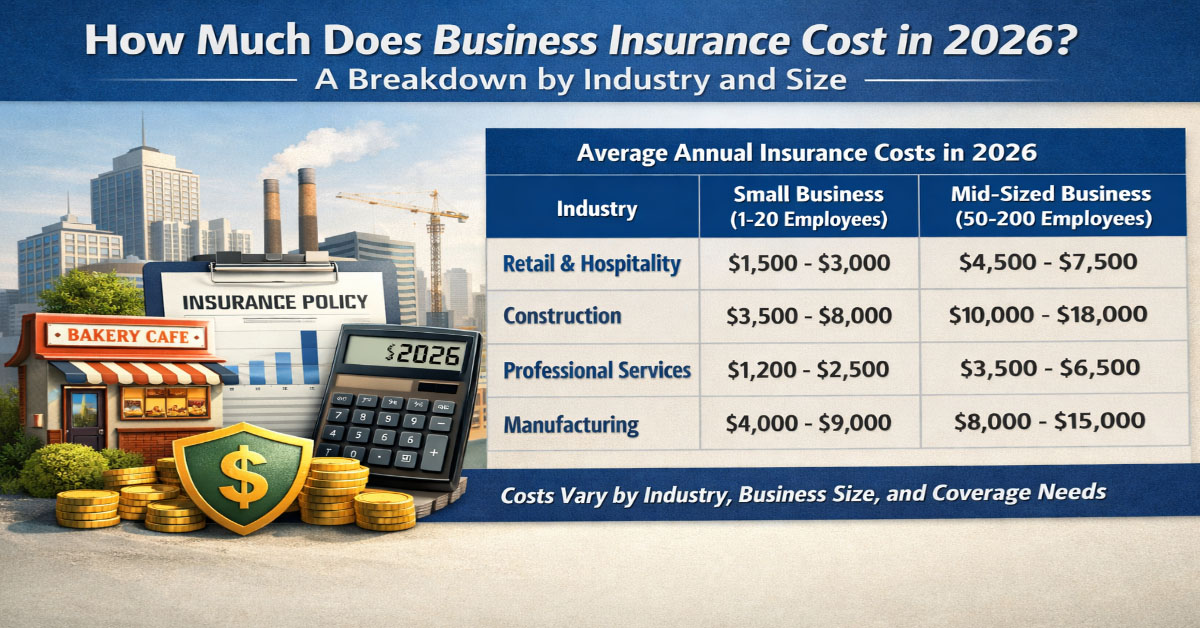
Workers Compensation Rates by Industry: 2026 National Averages
State Funds vs Private Insurance
Workers compensation insurance is available from two sources in most states: private insurance carriers operating in the voluntary market and state workers compensation funds operated by state governments. Some states have monopolistic state funds where private market workers compensation insurance is not available and all employers must purchase coverage from the state fund. Most states allow employers to choose between private market carriers and a state fund that operates as either a competitive alternative or an insurer of last resort for employers who cannot obtain private market coverage due to claims history or industry classification.
Private market carriers are generally preferred when accessible because they typically offer broader return-to-work programs, more comprehensive loss control services, and more flexibility in policy terms and premium payment options than state funds. State funds fill an important role for employers who have experienced difficulty obtaining private market coverage and in some states are competitive on cost for standard risk profiles. The availability and pricing competitiveness of each option depends significantly on the specific state and the employer's risk profile within that state.
How to Reduce Your Workers Compensation Costs
Preventing workplace injuries through active safety management is the most powerful long-term workers compensation cost reduction strategy available to any employer. A safety program that includes written policies, regular safety training, systematic hazard identification and correction, appropriate personal protective equipment requirements and enforcement, and meaningful supervisor accountability for safety outcomes directly reduces the claim frequency that drives E-mod and therefore premium. The return on investment from effective workplace safety programs is measurable in workers compensation premium savings alone, making safety investment financially self-funding in many cases independent of the humanitarian value of preventing employee injuries.
Prompt reporting of all injuries to your insurer enables faster medical intervention that typically reduces the severity and total duration of claims. An injury that is treated promptly with appropriate occupational medicine care generally resolves faster and at lower total cost than one delayed for several days while the injured worker attempts self-management. Some employers resist reporting minor injuries due to concern about claims impact, but OSHA recordkeeping obligations and the risk of a minor unreported injury evolving into a larger, uncontrolled liability make prompt reporting the correct approach in almost all circumstances.
An active return-to-work program that provides modified or transitional duty assignments for injured workers reduces the duration of temporary disability payments, which is typically the largest component of most workers compensation claim costs beyond medical. An injured employee who returns to a transitional role performing tasks within their medical restrictions within days of injury rather than remaining completely absent for weeks or months generates dramatically lower total claim costs and preserves their connection to the workplace during recovery. Modified duty programs require management creativity and administrative support but produce measurable E-mod improvement and premium reduction benefits that compound over the multi-year experience period.
Managing Injuries and Claims Effectively
Effective claims management begins at the moment of injury. A well-designed injury response process that routes injured employees to designated occupational health providers, ensures immediate supervisor reporting, and initiates prompt contact with the claims adjuster improves outcomes at every stage of the claim. Designated occupational health providers who understand the employer's available modified duty assignments can facilitate early return to work more effectively than emergency rooms or general practice physicians who may not be aware of what the employer can accommodate.
Maintaining regular communication with injured employees during their recovery demonstrates organizational concern for their wellbeing and maintains the employment relationship in ways that reduce the likelihood of attorney involvement. Workers compensation claims involving attorneys resolve at significantly higher cost and duration than claims managed without attorney involvement. The most effective way to reduce attorney involvement is treating injured employees respectfully, ensuring their medical needs are being met promptly and appropriately, and maintaining transparent communication about their claims status and return-to-work timeline.
Who Is Not Covered by Workers Compensation
Workers compensation covers employees in the course and scope of their employment and does not cover injuries that occur outside of employment. An employee injured during their commute to work is generally not covered. An employee injured during a purely personal activity while on a business trip may or may not be covered depending on the circumstances and state law. Workers compensation does not cover independent contractors who are genuinely independent under applicable state tests for determining contractor versus employee status.
Business owners themselves may or may not be covered depending on their state, their business entity type, and whether they have affirmatively elected coverage. In many states, sole proprietors and general partners are automatically excluded from their own workers compensation policy but can elect coverage if desired. Electing coverage for yourself as a business owner provides protection if you are injured in your own business operations and ensures that any injury you sustain is handled through the workers compensation system rather than requiring you to rely on personal health insurance for what is functionally an occupational injury.
Understanding Certificate of Insurance Requirements
A Certificate of Insurance, commonly called a COI or ACORD certificate, is a standardized document that provides summary evidence of an insurance policy's existence and key terms. Clients, landlords, general contractors, event venues, and government agencies routinely require businesses to provide a COI as a condition of doing business, signing a lease, or obtaining a permit. Understanding what a COI contains, what it represents, and what it does not promise is important for business owners on both sides of this requirement.
A standard ACORD 25 certificate shows the insured's name and address, the insurance companies providing coverage, the types of coverage in force, the policy numbers, the effective and expiration dates, and the coverage limits for each policy type. It also shows any additional insured endorsements and any certificate holder who must be notified of policy cancellation. The bottom of the certificate typically contains language clarifying that the certificate is for informational purposes only and does not amend, alter, or extend the coverage provided by the policies shown.
For business owners who are asked to provide a COI, contact your commercial insurance broker or agent. Your insurer can typically produce a COI within 24 to 48 hours. If the requesting party requires specific language about additional insured status or waiver of subrogation, your agent must add these endorsements to the underlying policy, which may take additional time and may involve an additional premium. Agree to these endorsement requirements with your insurer before committing to contractual terms with a client that require them.
For business owners who require COIs from vendors and subcontractors before allowing them to work on their property or projects, establish a tracking system that captures each COI, its expiration date, and a reminder to request renewal before expiration. An expired COI provides no protection, and a vendor operating with lapsed coverage while on your property creates liability exposure for your business if that vendor causes injury or damage during the gap period.
Insurance coverage decisions benefit from regular review because both your circumstances and the insurance market change continuously. Setting a calendar reminder to review your coverage at least 30 days before each renewal gives you time to compare quotes, evaluate coverage changes, and make adjustments based on changes in your financial situation, family structure, or risk exposure. The most effective insurance strategy is not a one-time decision but an ongoing process of alignment between your coverage structure and your actual needs and financial capabilities.