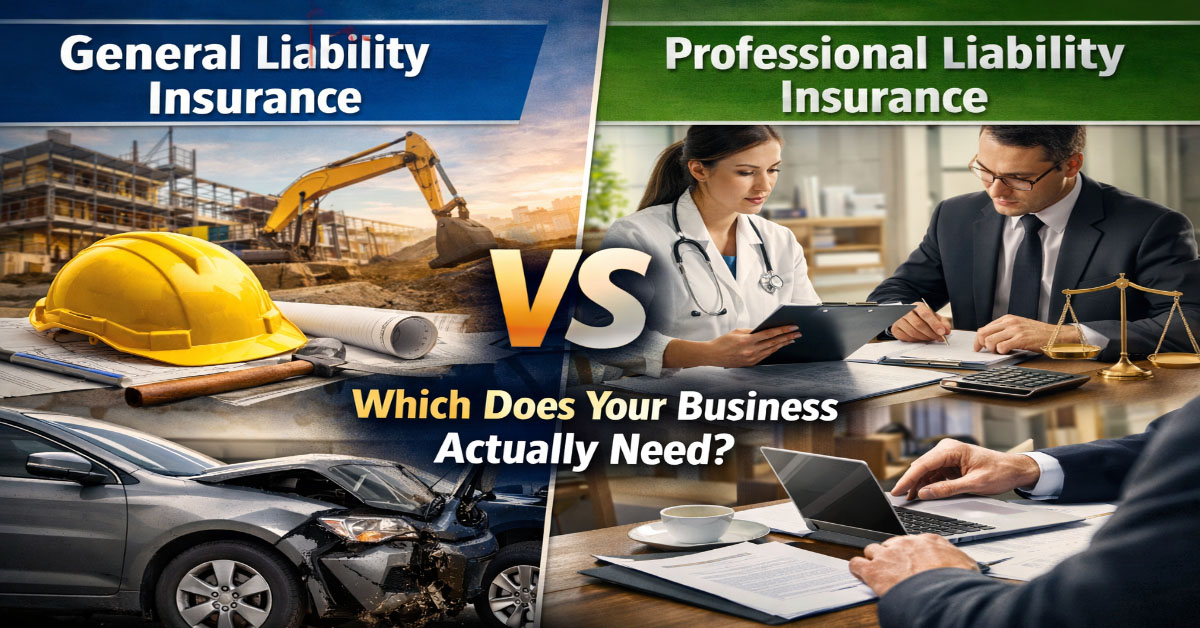
General liability insurance and professional liability insurance are two of the most commonly purchased and most commonly confused types of commercial insurance. They cover fundamentally different risks, respond to different types of claims, and are needed by different categories of businesses, though many businesses need both. Choosing only one when you need both represents dangerous underprotection. Paying for one when you primarily need the other wastes premium dollars. Getting this right is a basic commercial insurance competency for any business owner.
This guide explains exactly what each coverage type protects against, provides concrete claim scenarios that illustrate the practical difference, covers what each type costs in 2026, and gives you a clear framework for determining which coverage your specific business needs.
In This Article
- General Liability: What It Covers
- Professional Liability: What It Covers
- The Core Difference: Physical vs Economic Harm
- Claim Scenarios That Illustrate the Difference
- Who Needs General Liability
- Who Needs Professional Liability
- Why Many Businesses Need Both
- What Each Type Costs in 2026
- The Business Owners Policy Starting Point
- Claims-Made vs Occurrence: A Critical Technical Distinction
General Liability Insurance: What It Covers
General liability insurance, also called commercial general liability or CGL, protects your business against third-party claims of bodily injury and property damage arising from your business operations, your premises, and your products or completed work. It is the foundational commercial insurance coverage that most businesses of any size should carry as a baseline protection against the most common physical harm claims that any business activity can generate.
The three primary coverage components of a standard CGL policy are premises and operations liability, products and completed operations liability, and personal and advertising injury liability. Premises and operations liability covers bodily injury or property damage that occurs on your business premises or as a result of your ongoing business operations while they are being performed. Products and completed operations liability covers bodily injury or property damage that results from your products after they have left your control or from your completed work after you have finished performing it. Personal and advertising injury covers certain non-physical harms including defamation, copyright infringement in advertising, false advertising, and invasion of privacy.
A standard CGL policy does not cover professional errors or omissions. It does not cover employee injuries. It does not cover damage to your own business property. It does not cover auto accidents involving business vehicles. It does not cover intentional acts. These gaps are addressed by professional liability insurance, workers compensation, commercial property, commercial auto, and other specific coverage products designed for those particular risk categories.
Professional Liability Insurance: What It Covers
Professional liability insurance, also called errors and omissions insurance or E and O, protects your business against claims that you made a mistake, gave bad advice, failed to perform the service you were contracted to provide, or otherwise delivered professional services in a way that caused a client to suffer a financial loss. Unlike general liability insurance that responds to physical harm, professional liability responds to economic harm. The claim does not require that anyone was physically injured or that any property was physically damaged; the harm is purely financial.
For certain licensed professions including medicine, law, and architecture, professional liability insurance goes by specific names that reflect the profession's particular liability framework. Medical malpractice insurance is professional liability for healthcare providers. Legal malpractice insurance is professional liability for attorneys. These profession-specific products have underwriting criteria and coverage terms tailored to the specific nature of professional services and the regulatory and legal framework of those licensed professions.
Professional liability coverage typically pays for your legal defense costs and any judgment or settlement up to the policy limit for covered claims. Legal defense costs in professional liability matters can run $50,000 to $300,000 or more even for claims that are ultimately unsuccessful against the insured defendant. The coverage of defense costs alone, regardless of how the claim is ultimately resolved, provides significant financial protection for any professional services business whose core offering is expertise and judgment rather than physical deliverables.
The Core Difference: Physical vs Economic Harm
The clearest way to understand the boundary between general liability and professional liability is the nature of the harm alleged in the claim. If the harm involves physical injury to a person or physical damage to property, it is in the general liability territory. If the harm involves financial loss, lost opportunity, or economic damage resulting from the quality or content of professional services, it is in the professional liability territory.
A plumber who repairs a pipe and the repair fails, flooding a client's basement and damaging their furniture, has caused physical property damage. This is a general liability completed operations claim. A financial advisor who recommends an investment that loses a client $200,000 has caused economic harm through professional advice. This is a professional liability claim. No general liability policy covers this regardless of how the claim is framed, because the harm is financial rather than physical.
Claim Scenarios That Illustrate the Difference
Scenario 1: The Slip and Fall
A customer visits your retail store, slips on a wet floor near the entrance, and suffers a broken wrist. They sue for medical costs and lost wages totaling $85,000. This is a general liability premises claim. Your CGL policy pays for the defense and any settlement or judgment up to your policy limit.
Scenario 2: The IT Consultant Error
You are an IT consultant who migrates a client's data to a new system. Due to an error in your migration process, the client loses three months of historical customer records that cannot be recovered. The client sues for the business impact of the data loss, claiming $180,000 in economic harm. This is a professional liability claim. The harm is purely economic, there was no physical damage to any property, and the claim arises from the quality of your professional work. Your general liability policy will not cover this claim under any theory.
Scenario 3: The Marketing Agency
A marketing agency designs a campaign that the client claims failed to deliver projected results, causing them to miss revenue targets. The client sues for $250,000 in lost revenue. This is an E and O professional liability claim for failure to deliver promised professional services results. The same agency also inadvertently uses imagery similar to a competitor's trademarked logo in advertising materials. The competitor sues for trademark infringement. This is a personal and advertising injury claim under the agency's general liability policy. This example illustrates how a single business can face both types of claims from two different client situations.
Scenario 4: The Construction Contractor
A general contractor completes a commercial renovation. Six months later, the client discovers water damage from improper flashing installation around the new windows. This is a completed operations claim under the contractor's general liability policy because the harm is physical property damage from completed work. This is not a professional liability matter because the harm is not from the quality of professional advice but from the physical execution of the construction work.
Who Needs General Liability Insurance
General liability insurance is appropriate for virtually every business that operates a physical location, has contact with customers or members of the public, delivers products, or performs any work that results in a physical deliverable or outcome. Retail stores, restaurants, contractors, manufacturers, distributors, landlords, event organizers, and any business with customer-facing operations needs general liability coverage. Most commercial leases require tenants to carry general liability insurance as a condition of the lease. Most commercial contracts with larger clients and government agencies require certificate of insurance proof of general liability coverage as a condition of doing business.
Who Needs Professional Liability Insurance
Professional liability insurance is appropriate for any business or individual whose primary service offering involves providing expertise, advice, recommendations, designs, or other knowledge-based deliverables to clients who rely on the quality and accuracy of that work. The diagnostic question is: if my work product or advice turns out to be wrong, incomplete, or unsatisfactory, could my client suffer a significant financial loss for which they might hold me responsible? If yes, you need professional liability insurance. Businesses that consistently need professional liability coverage include technology consultants and developers, management consultants, financial advisors, insurance agents and brokers, real estate agents and appraisers, architects and engineers, accountants and tax preparers, marketing and advertising agencies, HR consultants, healthcare providers, attorneys, therapists, educators, and any other business whose primary deliverable is a service based on specialized knowledge and professional judgment.
Why Many Businesses Need Both
A significant number of businesses genuinely need both general liability and professional liability coverage because their operations create exposure to both types of claims simultaneously. A consulting firm that visits client offices, conducts meetings, and provides both advice and implementation services has both premises liability exposure and professional liability exposure from the same operations. A healthcare facility that provides both physical care and professional medical judgment has obvious exposure in both categories from every patient encounter. A technology services company that develops software and also installs hardware at client sites has both completed operations exposure and professional services exposure from its two types of client deliverables. For these businesses, the question is not which coverage to buy but how to structure the combination most efficiently and cost-effectively.
General Liability vs Professional Liability: 2026 Cost Ranges
The Business Owners Policy: A Starting Point
A Business Owners Policy bundles general liability, commercial property, and business interruption coverage into a single package policy designed for small and medium-sized businesses. The BOP is typically the most cost-efficient starting point for small business commercial insurance because the bundled packaging produces better pricing than purchasing each component separately. Most BOPs do not include professional liability. These coverages are typically purchased separately alongside the BOP. Some insurers offer enhanced BOP products that allow professional liability to be added as an endorsement, which can simplify policy management and potentially produce pricing advantages for businesses that need both general and professional liability coverage under a single insurer relationship.
Claims-Made vs Occurrence: A Critical Technical Distinction
Professional liability policies are typically written on a claims-made basis, which means the policy covers claims that are made against you during the policy period, regardless of when the underlying incident occurred. General liability policies are typically written on an occurrence basis, meaning the policy covers incidents that occur during the policy period, regardless of when the claim is later made.
The claims-made structure of professional liability policies creates an important planning consideration when changing insurers or retiring from professional practice. If your policy does not include an extended reporting period endorsement called a tail, claims made after your policy expiration for work performed while the policy was in force will not be covered. Purchasing a tail coverage endorsement when terminating a claims-made professional liability policy extends the reporting period for incidents that occurred while the policy was active. The cost of tail coverage is typically 150 to 200 percent of your final annual premium paid as a one-time amount, and it is an essential purchase for any professional who is retiring from practice or changing insurers after years of claims-made coverage.
Understanding Certificate of Insurance Requirements
A Certificate of Insurance, commonly called a COI or ACORD certificate, is a standardized document that provides summary evidence of an insurance policy's existence and key terms. Clients, landlords, general contractors, event venues, and government agencies routinely require businesses to provide a COI as a condition of doing business, signing a lease, or obtaining a permit. Understanding what a COI contains, what it represents, and what it does not promise is important for business owners on both sides of this requirement.
A standard ACORD 25 certificate shows the insured's name and address, the insurance companies providing coverage, the types of coverage in force, the policy numbers, the effective and expiration dates, and the coverage limits for each policy type. It also shows any additional insured endorsements and any certificate holder who must be notified of policy cancellation. The bottom of the certificate typically contains language clarifying that the certificate is for informational purposes only and does not amend, alter, or extend the coverage provided by the policies shown.
For business owners who are asked to provide a COI, contact your commercial insurance broker or agent. Your insurer can typically produce a COI within 24 to 48 hours. If the requesting party requires specific language about additional insured status or waiver of subrogation, your agent must add these endorsements to the underlying policy, which may take additional time and may involve an additional premium. Agree to these endorsement requirements with your insurer before committing to contractual terms with a client that require them.
For business owners who require COIs from vendors and subcontractors before allowing them to work on their property or projects, establish a tracking system that captures each COI, its expiration date, and a reminder to request renewal before expiration. An expired COI provides no protection, and a vendor operating with lapsed coverage while on your property creates liability exposure for your business if that vendor causes injury or damage during the gap period.
Insurance coverage decisions benefit from regular review because both your circumstances and the insurance market change continuously. Setting a calendar reminder to review your coverage at least 30 days before each renewal gives you time to compare quotes, evaluate coverage changes, and make adjustments based on changes in your financial situation, family structure, or risk exposure. The most effective insurance strategy is not a one-time decision but an ongoing process of alignment between your coverage structure and your actual needs and financial capabilities.