Life insurance is often mentally categorized as something to think about later, after you have a spouse, after you have children, after you have a mortgage. For young adults in their 20s and 30s in 2026, this deferral is one of the most expensive financial mistakes they can make, not because they are at high risk of dying, but precisely because they are not. The premiums available to a healthy 26-year-old are dramatically lower than those available to the same person at 36 or 46, and every year of delay converts into permanently higher lifetime insurance costs that compound over decades.
This guide makes the case for young adult life insurance in 2026, explains exactly who needs it and who does not yet, describes what type and how much coverage to buy, and shows how to secure coverage at the lowest available rate through the most efficient modern application process.
In This Article
- Why Buying Now Produces Dramatically Lower Lifetime Costs
- Who Actually Needs Life Insurance in Their 20s and 30s
- Who Can Reasonably Wait
- How Much Coverage Young Adults Need
- Term Life vs Other Options for Young Adults
- What Life Insurance Costs for Young Healthy Adults in 2026
- How to Buy Efficiently: The Modern Application Process
- Employer Coverage Gaps and Why They Matter
- The Convertibility Advantage
Why Buying Now Produces Dramatically Lower Lifetime Costs
Life insurance premiums are primarily driven by age and health. Younger, healthier applicants pay lower premiums than older applicants for the same coverage. This is not a minor pricing variation. The cost difference between buying at 26 versus 36 versus 46 is substantial and permanent for the duration of the policy.
A healthy 26-year-old male non-smoker can obtain a 30-year, $500,000 term policy for approximately $22 to $30 per month. The same coverage at 36 costs approximately $40 to $55 per month. At 46, it costs approximately $85 to $120 per month. Buying at 26 rather than 36 saves approximately $18 to $25 per month for 30 years, a cumulative premium saving of $6,500 to $9,000 over the policy period while receiving the same $500,000 in protection throughout.
The gap is even more stark for people whose health changes between their 20s and 30s or 40s. A 26-year-old in excellent health qualifies for preferred-plus underwriting classes that produce the lowest available rates. If that same person develops a common condition like Type 2 diabetes, high blood pressure, or elevated cholesterol in their 30s, they may qualify only for standard or substandard rates that are 25 to 100 percent higher than the preferred rates they would have received a decade earlier. Locking in a preferred rate in your mid-20s before any health changes occur is a form of financial risk management whose value is difficult to quantify in advance but can be very significant in retrospect.
Cost Comparison by Purchase Age: 30-Year Term, $500,000, Male Non-Smoker
Who Actually Needs Life Insurance in Their 20s and 30s
You should buy life insurance now if any of the following describe your situation. You have a spouse or domestic partner who depends on your income for their financial stability or who has co-signed debt obligations with you. You have children, including children you might plan to have in the near future, because buying before pregnancy is particularly advantageous for women who want to lock in pre-pregnancy rates and health classifications. You have a mortgage or significant co-signed debt that your death would leave as a burden for a surviving family member or co-borrower. You are caring for aging parents who depend on your financial contribution to their wellbeing. You have student loan debt that was co-signed by a parent and would not be discharged at your death, leaving that parent with the obligation.
Even without existing dependents, many financial advisors recommend that young adults in excellent health purchase a 20 or 30-year term policy precisely because of the rate advantage and insurability lock-in. The cost at 25 or 26 is low enough that the value of securing insurability before any health changes occur justifies the premium even for someone whose coverage need is currently modest.
Who Can Reasonably Wait
If you are single with no dependents, no co-signed debt, no one financially dependent on your income, and no plans to change any of these circumstances in the near term, the urgency of buying life insurance is genuinely lower. The coverage need does not currently exist in a meaningful way. However, if you are in this situation at 22 to 25, the premium cost of buying a 30-year term policy is extraordinarily low and the option value of locking in rates and insurability at peak health is real. Spending $20 to $25 per month on a $500,000 30-year term policy as a 24-year-old is not irrational even without current dependents, because the future coverage need is predictable and the cost of waiting grows every year.
How Much Coverage Young Adults Need
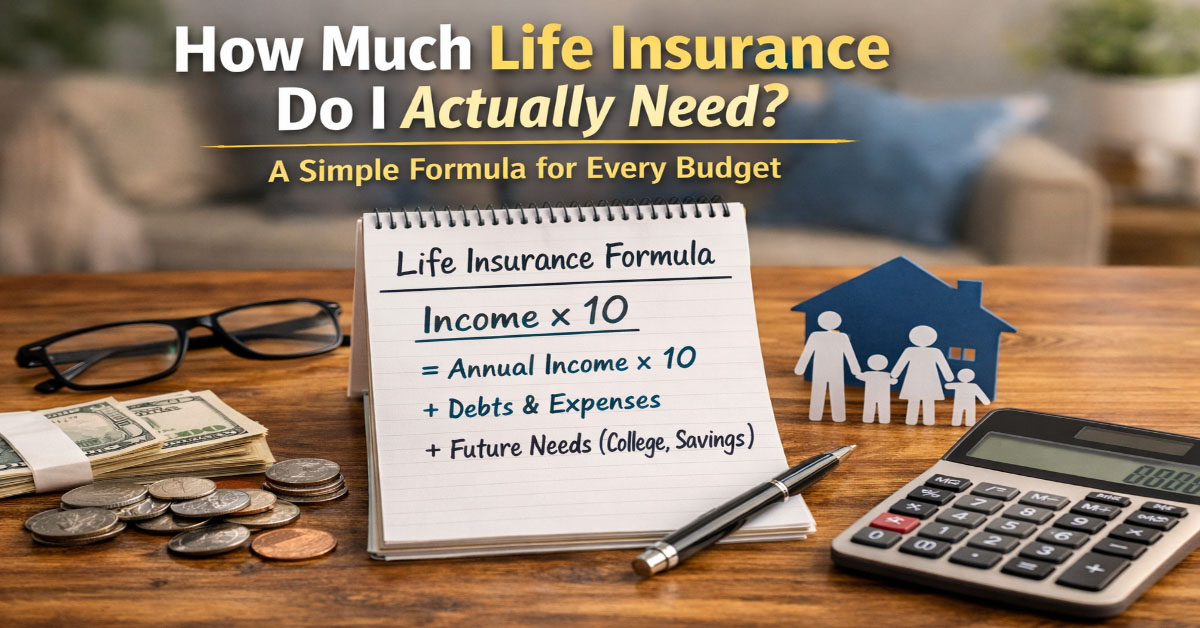
The standard guidance of 10 to 12 times annual income applies to young adults, though with adjustments for specific circumstances. A 28-year-old earning $65,000 with a spouse who earns $55,000, no children, and a $280,000 mortgage might reasonably carry $500,000 to $750,000 in coverage for each partner. A 32-year-old earning $90,000 with a non-working spouse and two young children might reasonably carry $1,000,000 to $1,500,000.
For young adults whose income is expected to grow significantly over the next 10 to 15 years, buying somewhat more coverage now at current income-based pricing than current income strictly requires is rational because coverage amounts cannot be increased after purchase without new underwriting. Buying $750,000 today when $500,000 might be strictly sufficient based on current income provides protection that will still be adequate even if income and financial obligations grow significantly over the policy period.
Term Life Is Right for Young Adults in Almost Every Case
For young adults, term life insurance is the appropriate choice in the overwhelming majority of situations. The premium differential between term and whole life is most dramatic for young buyers because a 25-year-old has the longest expected remaining lifespan, making a permanent policy the most expensive to fund from the insurer's perspective. The cost advantage of term over whole life for a 25-year-old is even more pronounced than for a 45-year-old. Paying $400 to $600 per month for whole life at 26 when $25 to $30 per month buys equivalent term coverage produces a premium differential that, invested instead, compounds over four decades into substantial wealth that far exceeds any whole life policy's cash value.
The legitimate exception for young adults is someone who has already been identified as having a specific estate planning or business planning need that requires permanent coverage, typically in consultation with an estate attorney and financial planner. These situations are rare at younger ages and do not describe the typical young adult buyer.
What Life Insurance Costs for Young Healthy Adults in 2026
Life insurance is dramatically less expensive for young healthy adults than most people assume. Survey data consistently shows that Americans in their 20s and 30s estimate the cost of term life insurance at three to five times the actual market rate, and this misperception is one of the primary reasons purchase decisions are deferred. Understanding the actual cost removes a significant psychological barrier to action.
A healthy 25-year-old female non-smoker pays approximately $15 to $22 per month for a 20-year, $500,000 term policy. A healthy 30-year-old male non-smoker pays approximately $22 to $30 per month for the same coverage. A healthy 35-year-old of either sex pays $25 to $40 per month. These are genuinely low costs relative to the financial protection provided. For most young adults, the monthly life insurance premium is less than a streaming service subscription, less than a monthly gym membership, and a fraction of a car insurance premium.
How to Buy Efficiently: The Modern Application Process
The modern life insurance application process for young, healthy adults is substantially faster and less burdensome than it was a decade ago. Many carriers now offer accelerated underwriting that approves qualifying applicants without a medical exam, producing approval decisions in 24 to 72 hours through an entirely online process. Digital-first carriers including Ladder Life, Bestow, Haven Life, and Fabric by Gerber Life have built their entire business model around this frictionless experience.
For applicants who are genuinely healthy, have no significant medical history, and are applying for coverage amounts under approximately $1,000,000 to $2,000,000, the accelerated process is typically the fastest and most convenient path to coverage. The approval is based on algorithmic review of medical databases, prescription history, and driving records rather than a physical exam, producing decisions within days rather than the three to six weeks traditional underwriting required.
Applicants with any health conditions, family history concerns, or complex situations may receive better risk class assignments through traditional full underwriting that includes a paramedical exam and more comprehensive medical review. If an accelerated application comes back with a less favorable rate than expected, requesting a full underwriting review is always an option and sometimes produces a materially better outcome for applicants whose health data in databases is incomplete or outdated.
Employer Coverage Gaps and Why They Matter
Most employers offer group life insurance as a standard benefit, typically at one to two times the employee's annual salary with a common cap of $50,000 or $100,000. This coverage is valuable but has important limitations that young adults should understand before relying on it as their primary or only life insurance.
Group life insurance is not portable. When you leave your employer, the coverage ends or converts at a dramatically higher individual premium. For a 32-year-old who plans to change jobs, become self-employed, or take a career break, employer-provided life insurance provides coverage only during continuous employment at that specific employer. Individual term policies you own and control continue regardless of your employment status for the entire term period.
The coverage amount from employer group insurance is almost always substantially less than what a household with dependents and a mortgage actually needs. One times annual salary at $75,000 per year provides $75,000 in death benefit, insufficient to replace even one year of income for a family whose financial need extends across decades. Individual coverage supplements employer benefits to reach an adequate total coverage level and ensures continuity when employment changes.
The Convertibility Advantage
Most term life policies include a conversion option that allows you to convert the term policy to a permanent policy without new underwriting, typically up to a specified age or within a defined number of years before the term expires. The conversion is made at the permanent policy rates that apply to your attained age at conversion, without reference to your current health status. This means that if you develop a health condition during the term period, you retain the option to convert to permanent coverage at attained-age rates rather than losing insurability entirely.
The conversion option is particularly valuable for young adults who are uncertain about their long-term insurance needs. Buying a 30-year term policy at 27 with a conversion option preserved to age 65 provides 30 years of pure term protection at favorable rates while maintaining the option to convert if a permanent insurance need develops during that period. Understanding the specific conversion terms in any policy you consider, including the deadline for conversion and the permanent products available for conversion, helps you evaluate this option's practical value before purchase.
The Life Insurance Application and Underwriting Process
Understanding what happens between submitting a life insurance application and receiving your policy approval helps you prepare effectively, avoid surprises, and set accurate expectations for the timeline and outcome. The underwriting process for term life insurance has become significantly more streamlined in recent years, with many carriers now offering accelerated underwriting that can approve a policy in days rather than weeks for qualifying applicants.
The application collects information about your health history, family medical history, tobacco and alcohol use, occupation, income, aviation or hazardous activity participation, and the amount and purpose of coverage you are seeking. For traditional underwriting, this is followed by a paramedical exam: a trained medical professional visits your home or office to collect height, weight, blood pressure, pulse, and a blood and urine sample. Results are reviewed by the insurer's underwriting team along with prescription history from database sources and your driving record.
Based on underwriting results, you are assigned to a risk class: preferred plus, preferred, standard plus, standard, or substandard table ratings for elevated risk profiles. The risk class determines the premium you are offered. If you qualify for a better risk class than your initial estimate, you pay a lower premium than quoted. If underwriting reveals a health condition that increases your risk, you may be offered coverage at a higher premium than initially estimated or declined for coverage in rare cases.
Accelerated underwriting programs, now available from most major carriers for applicants under 60 seeking coverage under $1,000,000 to $2,000,000, use algorithmic review of medical database records, prescription history, and driving record to approve policies without a physical exam. These programs can produce approval decisions in as little as 24 to 72 hours. For healthy applicants with clean records, accelerated underwriting offers the convenience of no exam with competitive pricing. Applicants with health conditions or complex profiles may receive better risk class assignments through traditional full underwriting that includes a physical exam and more comprehensive medical history review.
Naming Beneficiaries: The Most Important Decision After Buying Coverage
The beneficiary designation on a life insurance policy determines who receives the death benefit when the insured dies. This designation supersedes any instructions in a will. It is one of the most consequential financial decisions a policyholder makes, and yet it is also one of the most commonly overlooked after the initial policy purchase.
Every life insurance policy should have a primary beneficiary and at least one contingent beneficiary designated. The primary beneficiary receives the death benefit if they are alive at the time of the claim. The contingent beneficiary receives the benefit if the primary beneficiary has predeceased the insured. Without a contingent beneficiary designation, the benefit would pass to the insured's estate if the primary predeceases them, which can trigger probate, creditor claims, and estate taxes that undermine the purpose of the coverage.
Review your beneficiary designations after every major life change: marriage, divorce, birth of a child, death of a named beneficiary, or significant change in family financial circumstances. Outdated beneficiary designations that still name an ex-spouse are an unfortunately common and easily preventable error that causes significant distress to surviving family members. Contact your insurer directly to update beneficiary information rather than relying on a will or other estate document, since the beneficiary designation on the policy itself is the legally controlling document.
Insurance coverage decisions benefit from regular review because both your circumstances and the insurance market change continuously. Setting a calendar reminder to review your coverage at least 30 days before each renewal gives you time to compare quotes, evaluate coverage changes, and make adjustments based on changes in your financial situation, family structure, or risk exposure. The most effective insurance strategy is not a one-time decision but an ongoing process of alignment between your coverage structure and your actual needs and financial capabilities.