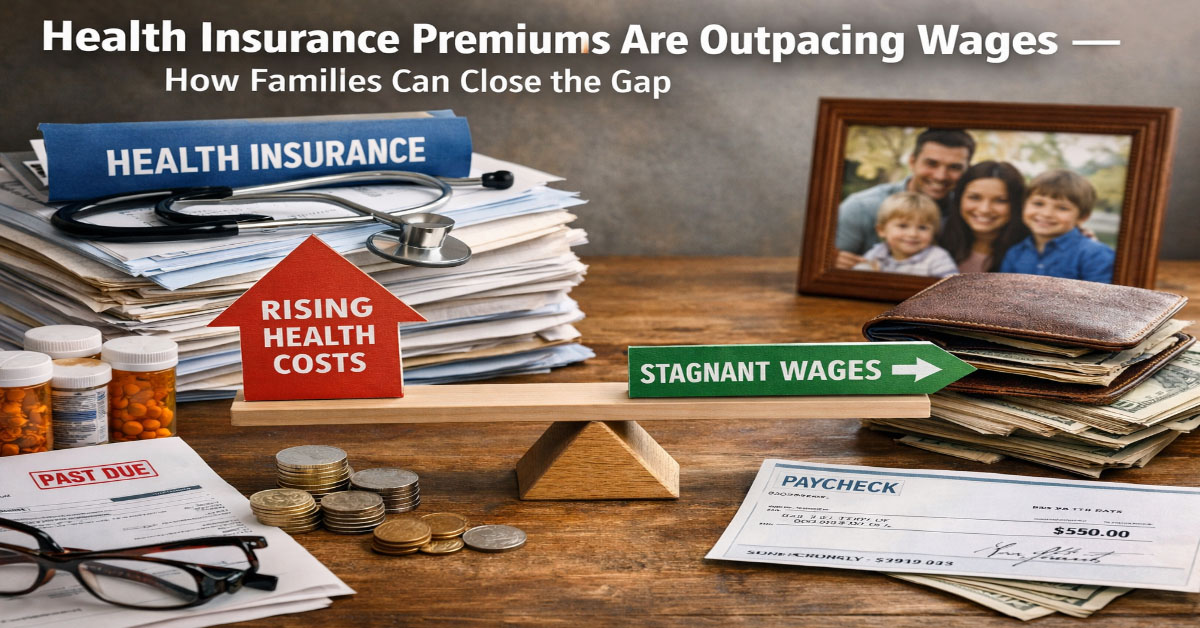
For most American workers, health insurance has become the second-largest household expense after housing, and the gap between what coverage costs and what wages can comfortably support has widened every year for more than two decades. In 2026, the expiration of enhanced ACA subsidies and the continued employer cost-shifting trend have combined to push the affordability gap to levels that are reshaping employment decisions, coverage selection, retirement timing, and financial planning for millions of households.
Understanding the data behind this trend, why it persists with no near-term resolution in sight, and what specific strategies can help manage the financial burden is practically important for every American navigating healthcare costs in 2026 and beyond.
In This Article
- The Premium vs Wage Growth Data
- Why Premiums Keep Rising Faster Than Wages
- What Employer Plans Cost in 2026
- What Marketplace Plans Cost in 2026
- The Employee Cost-Shifting Trend
- Who Bears the Heaviest Burden
- Practical Strategies to Manage the Burden
- The HSA as a Long-Term Strategy
- The Long-Term Outlook
The Premium vs Wage Growth Data
The KFF Employer Health Benefits Survey has documented a clear and consistent trend for decades: health insurance premiums have risen substantially faster than both wages and general inflation over any multi-year measurement period. Between 2000 and 2025, the average family premium for employer-sponsored coverage increased by approximately 335 percent. Over the same period, general inflation increased by approximately 90 percent and worker wages rose by approximately 145 percent.
This means the typical American household is spending a dramatically larger share of income on health insurance today than in 2000, 2010, or 2015. For middle-income families who do not qualify for Medicaid or substantial ACA subsidies and who lack access to generous employer coverage, healthcare costs have become a structural drag on discretionary spending, savings accumulation, and long-term financial security that did not exist at the same intensity for prior generations of American workers.
In 2026, the expiration of the enhanced ACA premium tax credits has accelerated this dynamic for marketplace enrollees specifically. Households that paid $150 to $200 per month for marketplace coverage in 2025 are now paying $500 to $800 per month for equivalent coverage, an increase of 200 to 400 percent in effective monthly cost while their income has remained substantially unchanged.
Health Insurance Cost Growth vs Wages: Long-Term Data
Why Premiums Keep Rising Faster Than Wages
Several structural forces drive health insurance premiums upward faster than general economic growth and wages. Hospital system and physician practice consolidation has increased providers' pricing power as the number of competing systems in most markets has declined through mergers and acquisitions. When a single health system controls most of the hospital capacity in a region, it faces limited competitive pressure to constrain pricing in negotiations with insurers.
The absence of effective price transparency in most healthcare markets means patients rarely price-shop for services, preventing the normal consumer pressure that restrains prices in other markets. Employer-sponsored insurance insulates employees from the true cost of the care they consume, further reducing the price sensitivity that would otherwise moderate utilization and prices. Pharmaceutical pricing reflects patent exclusivity periods and limited generic competition for many high-cost specialty drugs, with prices for new drugs bearing no necessary relationship to development cost. And an aging population whose increased healthcare utilization drives costs higher across the risk pools that fund coverage for all age groups creates persistent upward pressure independent of any other factor.
Unlike most goods and services in a market economy, healthcare in the United States does not respond predictably to competitive price pressure because patients cannot evaluate quality differences between providers for most services, billing complexity creates information asymmetries that prevent informed decision-making, and the fee-for-service payment model rewards volume of services provided rather than outcomes achieved.
What Employer Plans Cost in 2026
The KFF Employer Health Benefits Survey annual data shows average employer-sponsored family coverage premiums of approximately $25,572 in 2025, of which employees contributed approximately $6,575 on average annually. Single coverage averaged approximately $8,951, with employee contributions of approximately $1,362. These averages obscure enormous variation driven by employer size, industry, geographic location, and plan design choices.
Large employers with strong bargaining power and favorable employee demographics offer coverage at significantly lower employee contributions than small employers. A large technology company may offer family coverage with employee contributions of $3,000 to $4,000 per year. A small business with 15 employees in a high-cost state may offer family coverage at employee cost of $12,000 to $18,000 per year, making it effectively unaffordable at middle-income wages even though it technically constitutes employer coverage that eliminates marketplace subsidy eligibility.
What Marketplace Plans Cost in 2026
For individuals and families accessing coverage through the ACA marketplace, 2026 represents a significant and painful inflection point. The expiration of enhanced subsidies has produced effective premium increases of 50 to 300 percent for households that were heavily subsidized in 2025. For households above 400 percent of the Federal Poverty Level that lose subsidy eligibility entirely, the full unsubsidized premium represents a genuine affordability crisis in many markets.
An unsubsidized silver plan for a 45-year-old in a mid-range premium state costs approximately $500 to $700 per month in 2026. For a couple in their late 50s, unsubsidized silver plan premiums of $1,400 to $1,800 per month for the pair are common in many markets. These figures represent 15 to 25 percent of household income for middle-income earners, a share that most financial planners would characterize as structurally unsustainable as a long-term household budget allocation.
The Employee Cost-Shifting Trend
The movement of healthcare cost responsibility from employers to employees has accelerated consistently for more than a decade. Average employee deductibles have increased substantially. The share of employers offering high-deductible health plans as the primary or only option has grown. Employee contributions to premiums have increased as a percentage of total premium. The expansion of co-insurance rather than flat copayments for high-cost services means employees bear a larger percentage of the cost of expensive medical events than in prior decades.
In practical terms, a worker with a family employer plan in 2026 may contribute $6,000 to $8,000 annually in premiums while also facing a family deductible of $3,000 to $6,000 before insurance covers most services beyond preventive care. A single hospitalization for a family member could require $6,000 to $9,000 in out-of-pocket spending before reaching the family out-of-pocket maximum, on top of the annual premium contribution. The total financial exposure from employer coverage has grown dramatically even as employers continue nominally covering a large share of the headline premium number.
Workers see their effective wages stagnate because an increasing share of total compensation goes to healthcare costs that never appear on a paycheck. Economists call this the benefits wedge: the gap between what an employer pays to employ someone and what that worker actually takes home grows as healthcare costs grow, consuming compensation increases that workers might otherwise receive as wages.
Who Bears the Heaviest Burden
The affordability problem is most acute for workers at small employers, workers in industries with low employer coverage rates including retail, food service, construction, and agriculture, self-employed individuals purchasing individual coverage, households above ACA subsidy thresholds who lack employer coverage, and adults in the 55 to 64 age range who face the highest marketplace premiums but have not yet reached Medicare eligibility.
These groups share the common characteristic of lacking access to either a large employer's substantially subsidized group coverage or a government program that limits their cost exposure through income-based assistance. The group experiencing the most severe combination of high absolute costs and limited assistance is precisely the working middle class that falls between these safety nets, a population too affluent for meaningful government assistance but not affluent enough to absorb costs that have grown to represent a significant and growing share of their income.
Practical Strategies to Manage the Cost Burden
While systemic solutions to healthcare cost growth require policy changes beyond any individual's control, several strategies can meaningfully reduce what individual households pay for health insurance and healthcare services. Optimizing your metal tier selection based on actual expected healthcare utilization rather than defaulting to the most familiar plan type is the foundation. Healthy adults who primarily need preventive care and catastrophic protection are almost always better served financially by a high-deductible plan with an HSA than by a first-dollar coverage plan with a higher premium. Adults with chronic conditions requiring regular specialist care and prescription medications need to calculate their actual total annual cost including premium, copayments, and prescription costs across all available plan options before choosing.
Checking your network carefully before enrolling in any plan prevents the expensive surprise of discovering that your preferred physicians or specialists are out-of-network after you have already committed to a plan for the year. Verifying network status involves more than checking the insurer's online directory, which is frequently out of date. Call your specific providers and ask whether they participate in the specific plan you are considering, not just the insurer's broader network.
Using all available tax-advantaged health spending tools is equally important. If you are enrolled in a qualifying HDHP, contribute the maximum allowed to your Health Savings Account. If your employer offers a Flexible Spending Account, use it for predictable medical expenses to capture the tax advantage. If you are self-employed, claim the self-employed health insurance deduction and maximize retirement account contributions to manage modified adjusted gross income for subsidy purposes.
The HSA as a Long-Term Strategy
The Health Savings Account is the most powerful tool available to households enrolled in qualifying high-deductible health plans for managing healthcare cost burden over a multi-year horizon. The triple tax advantage of HSA contributions, pre-tax contributions that reduce adjusted gross income, tax-free investment growth within the account, and tax-free withdrawals for qualified medical expenses, makes the HSA the most tax-efficient savings vehicle available in the U.S. tax code for healthcare purposes.
A household contributing the 2026 family maximum of $8,550 annually to an HSA from age 35 to 65, invested in a diversified index fund at a 7 percent average annual return, accumulates approximately $885,000 in tax-free healthcare funds by retirement. This represents meaningful financial security against the healthcare costs that are among the largest and most unpredictable expenses of retirement, when healthcare spending typically increases significantly just as income from employment ends.
The strategy requires the discipline to invest rather than spend HSA funds in years when healthcare needs are low, reserving the accumulated balance for future higher-cost periods rather than using the HSA as a current-year spending account. For households with the financial flexibility to cover current medical expenses from regular income while investing HSA contributions, this long-term accumulation strategy is one of the most valuable financial planning opportunities available to middle-income Americans.
The Long-Term Outlook
Nothing in the structural dynamics of American healthcare cost growth suggests a meaningful moderation in the premium-to-wage gap over the near or medium term. Hospital system consolidation continues. Pharmaceutical prices remain high by international comparison. Administrative complexity continues generating overhead costs that represent a large share of every healthcare dollar spent. The aging population will continue driving utilization higher. Policy interventions sufficient to structurally change these dynamics require political consensus that has not materialized in decades of sustained national debate.
The most prudent individual response to this long-term outlook is to build healthcare cost management into financial planning explicitly rather than treating it as an unavoidable expense category to be paid passively. Fund HSAs aggressively where eligible. Understand the true total annual cost of coverage options rather than focusing only on the monthly premium. Maintain healthy behaviors that reduce utilization of expensive medical services. Plan for healthcare cost exposure in retirement as one of the largest and least predictable financial risks of that life stage, not as an afterthought addressed only when Medicare eligibility approaches.
Understanding Explanation of Benefits Documents
An Explanation of Benefits document, commonly called an EOB, is the document your health insurer sends after a medical claim is processed. It is not a bill. It is an explanation of how the insurer applied your benefits to the claim submitted by your healthcare provider. Understanding how to read an EOB is essential for verifying that your claims are being processed correctly and for understanding your actual out-of-pocket financial responsibility for any medical service.
The EOB shows several key figures for each service line: the amount billed by the provider, the insurer's allowed amount (the negotiated rate for in-network services or the maximum the insurer considers reasonable for out-of-network services), the amount the insurer paid, and the amount that is your responsibility. The difference between the billed amount and the allowed amount is a contractual writeoff that you do not owe if the provider is in-network; this writeoff represents the benefit of having a negotiated network rate through your insurer.
Your responsibility amount is broken down into deductible applied, coinsurance, and copayment components. This allows you to track your progress toward your deductible and out-of-pocket maximum throughout the year. Many people discover discrepancies between what an EOB shows as their responsibility and what a provider bills them. When this occurs, contact your insurer before paying the provider's bill to verify which amount is correct under your policy terms. Billing errors in medical invoices are common, and the EOB is your authoritative record of what you actually owe.
Preventive Care: What Your Plan Must Cover for Free
Under the Affordable Care Act, all non-grandfathered health insurance plans are required to cover a defined list of preventive services at no cost to the patient when those services are delivered by an in-network provider. This means no copayment, no coinsurance, and the service does not count against your deductible. These covered preventive services include annual wellness visits, many cancer screenings, blood pressure and cholesterol testing, depression screening, immunizations on the CDC recommended schedule, and a range of screenings and counseling services tailored to specific age groups and risk factors.
The no-cost preventive care requirement is one of the most tangible and consistently valuable benefits of ACA-compliant health insurance for generally healthy adults who use medical services primarily for wellness maintenance. A family that takes advantage of all applicable no-cost preventive services receives hundreds of dollars in medical care value annually without any cost-sharing contribution. Understanding which services qualify and using them consistently is particularly important for HDHP enrollees who pay out of pocket for most non-preventive services until the deductible is met.
Insurance coverage decisions benefit from regular review because both your circumstances and the insurance market change continuously. Setting a calendar reminder to review your coverage at least 30 days before each renewal gives you time to compare quotes, evaluate coverage changes, and make adjustments based on changes in your financial situation, family structure, or risk exposure. The most effective insurance strategy is not a one-time decision but an ongoing process of alignment between your coverage structure and your actual needs and financial capabilities.