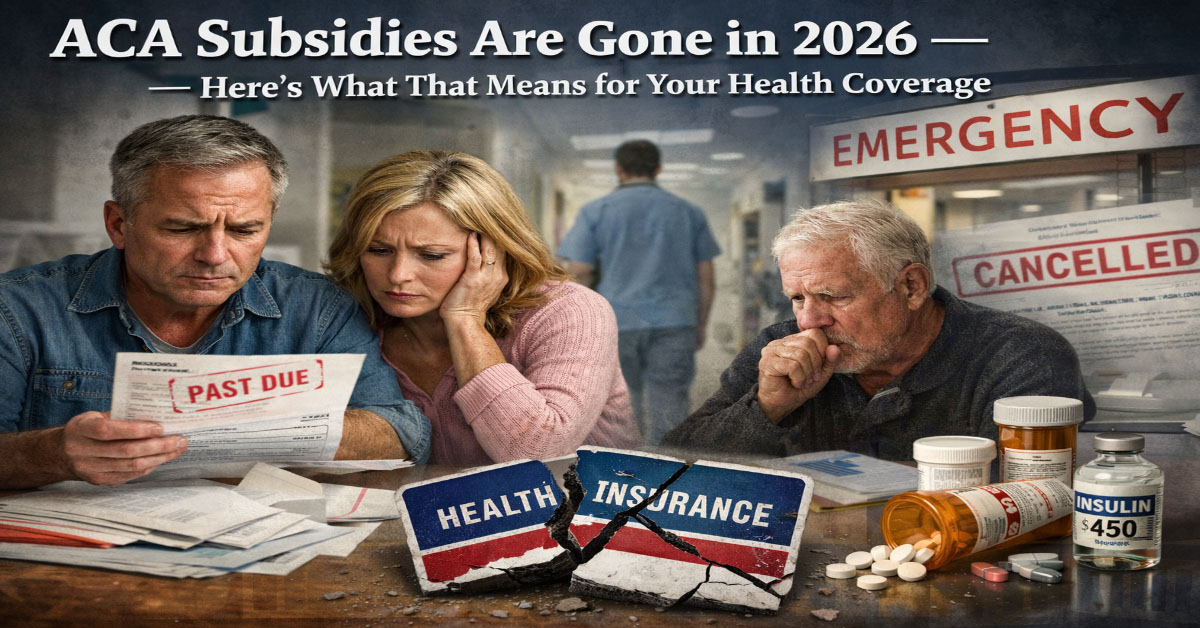
On January 1, 2026, the enhanced Affordable Care Act premium subsidies that had been in place for nearly five years expired without congressional extension. More than 22 million Americans, representing over 90 percent of all ACA marketplace enrollees, had been receiving these enhanced premium tax credits. For many, monthly premiums immediately doubled or tripled. An estimated four million people are projected to lose coverage entirely as a result of the expiration.
This is not a bureaucratic technicality. It is a concrete financial crisis affecting tens of millions of American families who made healthcare coverage decisions, employment decisions, and financial plans based on the subsidy structure that existed through 2025. Understanding exactly what changed, who is most affected, and what real options remain available is critical for anyone navigating the health insurance marketplace in 2026.
In This Article
- What the Enhanced Subsidies Were
- What Exactly Expired and What Remains
- The Scale of the Impact
- Who Is Most Affected
- The Return of the Subsidy Cliff
- What Real Premium Increases Look Like
- Your Options in 2026
- Medicaid: Are You Newly Eligible?
- Navigating the Marketplace Without Full Subsidies
- The Political Outlook
What the Enhanced Subsidies Were
To understand what was lost, it helps to understand what the enhanced subsidies provided. The original ACA premium tax credits established in 2014 limited what qualifying enrollees paid for premiums to a percentage of household income, scaled to income as a share of the Federal Poverty Level. The maximum contribution at the top of the original eligibility range, 400 percent of FPL, was approximately 9.5 percent of household income.
The American Rescue Plan Act of 2021 dramatically enhanced these subsidies in two important ways. First, it expanded eligibility beyond the original 400 percent of FPL ceiling, ensuring that even households earning above that threshold were protected from paying more than 8.5 percent of income for the benchmark silver plan premium. Second, it increased the subsidy amounts across all income levels, making coverage meaningfully more affordable for everyone already eligible under the original rules. These changes were extended through 2025 by the Inflation Reduction Act of 2022.
The sunset date was January 1, 2026. Congress did not pass an extension. The 2025 legislative package did not include subsidy extension. The enhanced subsidies expired as scheduled, and the original, lower subsidy structure snapped back into place for the 2026 plan year.
What Exactly Expired and What Remains
There is important confusion about the precise scope of this change. The ACA premium tax credit itself did not expire. What expired was the temporary enhancement of that credit established by the ARPA. The original, pre-enhancement ACA subsidies continue to exist and to provide financial assistance to eligible lower-income households. What changed on January 1, 2026 is that the expanded income eligibility above 400 percent of FPL was eliminated, reverting to the original hard cutoff. The subsidy amounts for those still eligible were reduced from the enhanced levels to the original, lower amounts.
This combination means some households lost all subsidy eligibility entirely and others saw their subsidy amounts decline substantially. Preventive care, essential health benefits, and consumer protections within ACA marketplace plans remain intact. The change is purely about financial assistance with premiums, not about the coverage requirements of plans themselves.
ACA Subsidy Expiration: Key Numbers
The Scale of the Impact
Twenty-two million Americans received enhanced premium tax credits in 2025. Of these, a significant portion have seen their monthly premiums increase substantially. The KFF Health Insurance Marketplace Calculator shows that for many households, the effective premium after subsidy in 2025 was $0 to $50 per month for individuals at lower income levels who now face $200 to $400 per month under the reverted original subsidy structure.
The average marketplace premium increase in 2026 is approximately 26 percent, but this national average obscures extreme variation. In high-premium states and rural areas with limited insurer competition, premium increases have been far more severe. Some households are reporting that their monthly premium has tripled or quadrupled from 2025 levels. An estimated four million people are projected to drop coverage entirely because even the most affordable available plan represents an unaffordable share of their household budget at 2026 prices without the enhanced subsidy.
Who Is Most Affected
Middle-Income Households Above the 400 Percent FPL Threshold
The group experiencing the most dramatic change is households earning above 400 percent of the Federal Poverty Level who had benefited from the ARPA expansion of eligibility. For a single person, that threshold is approximately $62,000 in 2026. For a family of four, it is approximately $127,000. Households earning above these amounts now receive zero premium tax credit regardless of how much their marketplace premium costs as a percentage of income. A family of four earning $130,000 that was previously receiving a subsidy limiting their premium contribution to 8.5 percent of income now pays the full unsubsidized premium, which in many states approaches or exceeds $2,000 per month for a comprehensive family plan.
Older Adults Approaching Medicare Eligibility
Adults aged 55 to 64 who are not yet Medicare-eligible face a particularly severe version of this problem. Marketplace premiums increase substantially with age under ACA rating rules, meaning this demographic already faces above-average premiums. Combined with the loss of subsidy protection, monthly premiums of $800 to $1,400 for a single individual in this age group are not uncommon in 2026 at the unsubsidized silver plan level in many states.
Rural Americans and High-Cost States
Marketplace premiums vary enormously by state and county due to different insurer participation rates, provider network costs, and state regulatory environments. In high-cost states and rural areas with limited insurer competition, the underlying premiums are highest and the impact of reduced subsidies is therefore most severe in absolute dollar terms.
Self-Employed and Small Business Owners
People who are self-employed or who own small businesses without group coverage rely entirely on the individual marketplace. This group has no employer contribution to offset rising premium costs and faces the full impact of the subsidy expiration alongside the premium increases that accompanied it. The ARPA had been particularly valuable for this demographic, and its expiration has created significant financial hardship for many self-employed Americans across a wide range of income levels.
People in Non-Medicaid Expansion States
Ten states have not expanded Medicaid under the ACA as of 2026. In these states, low-income adults who earn too much for traditional Medicaid but were newly eligible under ARPA's expanded subsidy structure now fall into a coverage gap: too much income for Medicaid, too little income to afford unsubsidized marketplace coverage. This group is disproportionately affected by the expiration and faces genuine coverage loss with no practical alternatives in the current market structure.
The Return of the Subsidy Cliff
One of the most pernicious aspects of the pre-ARPA ACA design was the subsidy cliff: the phenomenon where earning one dollar above 400 percent of FPL resulted in complete loss of all premium tax credit. A family of four earning $127,001 received zero subsidy while a family earning $126,999 received meaningful assistance. The ARPA eliminated this cliff by extending subsidy eligibility above 400 percent of FPL with a smooth phase-out. That protection disappeared January 1, 2026. The cliff is back.
This creates meaningful incentive structures for households near the threshold. Reducing modified adjusted gross income to stay below the threshold through retirement account contributions, deductible business expenses, or other legitimate income-reducing mechanisms can restore subsidy eligibility worth thousands of dollars annually. Households earning within approximately $10,000 above the threshold should consult a tax professional about income management strategies in the context of marketplace subsidy eligibility before the end of each tax year.
What Real Premium Increases Look Like
Abstract statistics about 26 percent average increases obscure very concrete financial realities. A 52-year-old self-employed consultant in Tennessee earning $85,000 annually who paid approximately $180 per month in 2025 with enhanced subsidy assistance now pays approximately $780 per month for equivalent coverage in 2026, a monthly increase of $600. Over twelve months, that is $7,200 in additional healthcare spending on income that has not increased proportionally.
A family of four in rural Colorado earning $140,000, who received moderate subsidy assistance under the ARPA expansion, now receives zero assistance. Their unsubsidized family plan premium went from approximately $600 per month to $1,750 per month. They have dropped coverage entirely, joining the projected four million Americans losing coverage in 2026.
Your Options in 2026
Check Whether You Still Qualify for Original ACA Subsidies
Before assuming you have no assistance available, verify your actual eligibility for the original ACA premium tax credit using current income thresholds. If your household income is below 400 percent of FPL, you may still receive meaningful premium assistance, though at a lower level than in 2025. Log into healthcare.gov or your state marketplace and run a current-year eligibility check with your actual projected income for 2026.
Explore Medicaid Eligibility
If your income has dropped or if you have had a qualifying life event that changes your household size or financial situation, you may newly qualify for Medicaid. Medicaid eligibility is determined by current income and household circumstances rather than historical patterns, so a change in your situation warrants a fresh eligibility check regardless of your prior coverage history.
Employer Coverage Through a Spouse or Family Member
If a spouse or family member has employer-sponsored coverage available that allows family enrollment, the comparison between marketplace and employer plan costs should be revisited in light of the new marketplace pricing. What may have been a marginal comparison in 2025 due to generous marketplace subsidies may now clearly favor the employer plan given full unsubsidized marketplace costs.
Bronze Tier Plans for Healthy Adults
Bronze tier marketplace plans have the lowest monthly premiums within the ACA framework but carry the highest deductibles and out-of-pocket maximums. For genuinely healthy adults who rarely use medical services and are primarily purchasing catastrophic protection, a bronze plan may represent the best value in the post-subsidy environment. Bronze plans that qualify as high-deductible health plans also enable HSA contributions, adding meaningful tax efficiency for higher-income enrollees.
Income Management to Stay Below the Subsidy Threshold
For households whose income is near the 400 percent FPL threshold, actively managing modified adjusted gross income to remain below the threshold can restore substantial subsidy eligibility. Strategies include maximizing pre-tax retirement contributions to 401k or SEP-IRA accounts, maximizing HSA contributions if enrolled in a qualifying HDHP, and for self-employed individuals, timing deductible business expenses appropriately. The financial value of subsidy eligibility in some scenarios exceeds the tax value of additional income above the threshold.
Medicaid: Are You Newly Eligible?
The subsidy expiration has driven significant interest in Medicaid eligibility among households that previously relied on marketplace subsidies. Medicaid eligibility is based on current household income and size, not prior coverage history. Several circumstances can create new eligibility. Income changes due to job loss, reduced hours, business revenue decline, or transition to retirement can push household income below Medicaid eligibility thresholds. In the 40 states that have expanded Medicaid, eligibility extends to adults earning up to 138 percent of FPL. For families with children, CHIP provides low-cost coverage for household incomes above Medicaid limits but below the point where marketplace plans are affordable.
Navigating the Marketplace Without Full Subsidies
For households that must navigate the marketplace in 2026 without the full subsidy benefit they received in 2025, strategic plan selection becomes more important than ever. The metal tier choice should be driven by expected healthcare utilization. Healthy adults who rarely use medical services are better served by bronze plans with lower premiums. Adults with chronic conditions, regular prescription needs, or planned medical procedures are better served by gold or silver plans where the lower cost-sharing more than offsets the higher premium over the policy year.
Network scrutiny is equally critical. Verifying that your specific physicians, specialists, and preferred hospital are in-network for any plan you are seriously considering, and obtaining documented confirmation rather than relying on network directory listings that are not always current, prevents expensive out-of-network surprises at exactly the moment when you are managing healthcare costs most carefully.
The Political Outlook
The expiration of the enhanced subsidies has become one of the most politically visible healthcare policy issues of 2026. Democratic elected officials have consistently advocated for reinstatement. Republican officials have generally opposed extension, characterizing the enhanced subsidies as pandemic-era emergency spending not intended to be permanent. The political calculus is complicated by the geographic reality that 88 percent of ACA marketplace enrollment growth since 2020 occurred in states that voted Republican in 2024, meaning the households losing coverage are disproportionately in red states, which creates political pressure on Republican officials whose constituents are directly harmed.
Multiple bipartisan proposals for targeted or modified subsidy restoration have been discussed in congressional circles as of mid-2026. Some form of partial restoration or restructuring remains possible before the end of the 2026 legislative calendar, though no deal has been reached as of the date of this article. Enrollment decisions for 2026 must be made based on the current law as it stands, not on the possibility of future legislative action that may or may not materialize.
Understanding Explanation of Benefits Documents
An Explanation of Benefits document, commonly called an EOB, is the document your health insurer sends after a medical claim is processed. It is not a bill. It is an explanation of how the insurer applied your benefits to the claim submitted by your healthcare provider. Understanding how to read an EOB is essential for verifying that your claims are being processed correctly and for understanding your actual out-of-pocket financial responsibility for any medical service.
The EOB shows several key figures for each service line: the amount billed by the provider, the insurer's allowed amount (the negotiated rate for in-network services or the maximum the insurer considers reasonable for out-of-network services), the amount the insurer paid, and the amount that is your responsibility. The difference between the billed amount and the allowed amount is a contractual writeoff that you do not owe if the provider is in-network; this writeoff represents the benefit of having a negotiated network rate through your insurer.
Your responsibility amount is broken down into deductible applied, coinsurance, and copayment components. This allows you to track your progress toward your deductible and out-of-pocket maximum throughout the year. Many people discover discrepancies between what an EOB shows as their responsibility and what a provider bills them. When this occurs, contact your insurer before paying the provider's bill to verify which amount is correct under your policy terms. Billing errors in medical invoices are common, and the EOB is your authoritative record of what you actually owe.
Preventive Care: What Your Plan Must Cover for Free
Under the Affordable Care Act, all non-grandfathered health insurance plans are required to cover a defined list of preventive services at no cost to the patient when those services are delivered by an in-network provider. This means no copayment, no coinsurance, and the service does not count against your deductible. These covered preventive services include annual wellness visits, many cancer screenings, blood pressure and cholesterol testing, depression screening, immunizations on the CDC recommended schedule, and a range of screenings and counseling services tailored to specific age groups and risk factors.
The no-cost preventive care requirement is one of the most tangible and consistently valuable benefits of ACA-compliant health insurance for generally healthy adults who use medical services primarily for wellness maintenance. A family that takes advantage of all applicable no-cost preventive services receives hundreds of dollars in medical care value annually without any cost-sharing contribution. Understanding which services qualify and using them consistently is particularly important for HDHP enrollees who pay out of pocket for most non-preventive services until the deductible is met.
Insurance coverage decisions benefit from regular review because both your circumstances and the insurance market change continuously. Setting a calendar reminder to review your coverage at least 30 days before each renewal gives you time to compare quotes, evaluate coverage changes, and make adjustments based on changes in your financial situation, family structure, or risk exposure. The most effective insurance strategy is not a one-time decision but an ongoing process of alignment between your coverage structure and your actual needs and financial capabilities.