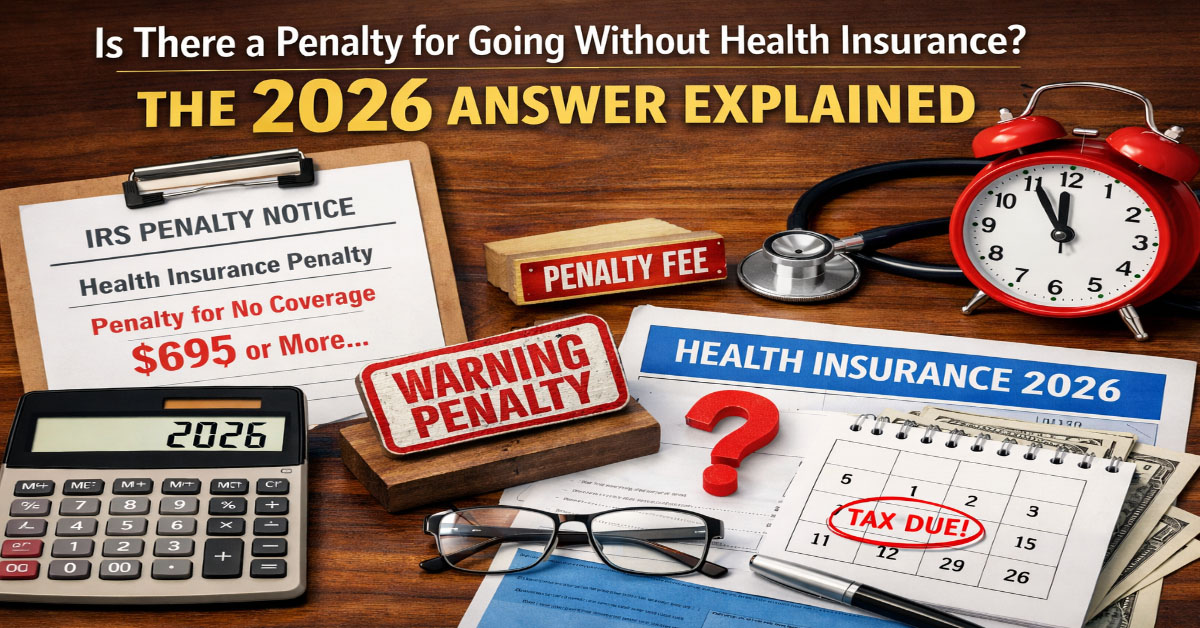
When the Tax Cuts and Jobs Act of 2017 reduced the federal individual mandate penalty to zero dollars starting in 2019, many Americans concluded there were no longer any consequences for going without health insurance. For most people in most states, that conclusion is technically accurate regarding government-imposed financial penalties. But it obscures a far more important set of consequences that have nothing to do with the IRS and everything to do with the catastrophic financial risk an uninsured person faces every day.
This guide gives you the complete and accurate picture: the current federal situation, the states that have active mandates with real financial penalties, who qualifies for exemptions, and the economic consequences of being uninsured that dwarf any government fine by orders of magnitude.
In This Article
The Federal Mandate: Zero Dollar Penalty Since 2019
The ACA's individual mandate required most Americans to maintain qualifying health coverage or pay a tax penalty. The Tax Cuts and Jobs Act of 2017 set the individual mandate penalty amount to zero dollars, effective for tax years beginning in 2019. If you do not have qualifying health coverage in 2026, you will owe no penalty on your federal tax return. The mandate technically still exists in federal law, but because the penalty is zero, it has no practical enforcement mechanism at the federal level.
To be precise: you must still indicate your coverage status on your federal tax return, but there is no financial consequence for indicating you lacked coverage. The mandate exists as statutory text; it simply carries no penalty.
States With Active Individual Mandate Penalties
Several states have enacted their own individual mandate laws that impose real financial penalties for lacking qualifying health coverage. These state penalties are collected through state tax returns and can be substantial. If you live in any of these states, the absence of a federal penalty does not protect you from state-level financial consequences.
States With Active Individual Health Insurance Mandates
State mandate penalties are not flat fees. They are income-based calculations that vary depending on household income, number of uninsured household members, and whether qualifying coverage was affordable and available during the penalty period. California's penalty can reach 2.5 percent of household income above the filing threshold for higher-income households. Massachusetts, which has had its own individual mandate since 2006 predating the federal ACA, ties its penalty to the premium for the lowest-cost qualifying coverage available in the state.
Who Is Exempt From State Individual Mandate Penalties
Every state with an individual mandate includes hardship exemptions and affordability exemptions that can significantly limit who actually owes the penalty. The most common exemption categories are the affordability exemption, which applies if the lowest-cost qualifying coverage available would cost more than approximately 8 percent of your household income; the coverage gap exemption, which typically exempts individuals uninsured for fewer than three consecutive months during the year; the religious conscience exemption for members of recognized religious groups with long-standing beliefs opposing insurance; health sharing ministry membership; and hardship exemptions for circumstances including homelessness, bankruptcy, natural disaster, domestic violence, and death of a close family member.
Given the post-subsidy premium levels in 2026, the affordability exemption is relevant for a broader range of households than it was in 2025 when enhanced ACA subsidies made coverage more affordable for more people. If your state has a mandate and you are uninsured, carefully evaluate your eligibility for the affordability exemption before assuming you will owe the full penalty.
The Real Financial Risk: Far Larger Than Any Penalty
The policy debate about mandate penalties has unfortunately created a mental framework where people evaluate the decision to be uninsured primarily in terms of the tax penalty they might or might not owe. This framework is entirely wrong for making a rational financial decision. The penalty, whether zero at the federal level or several hundred to a few thousand dollars at the state level, is irrelevant compared to the actual financial exposure of being uninsured.
Hospital chargemaster rates, the list prices hospitals charge uninsured patients before any negotiation, are among the most inflated prices in the U.S. economy. An emergency room visit for a moderately serious problem commonly runs $3,000 to $12,000 at chargemaster rates. A single night in a hospital averages $11,700 before any procedures or tests. A broken bone requiring surgical repair with hospitalization can run $20,000 to $50,000. A major acute illness or trauma event can reach $200,000 to $500,000 or more. These are real costs that uninsured Americans face with no coverage limit and no insurer negotiating discounted rates on their behalf.
The insured patient who reaches their out-of-pocket maximum under an ACA plan pays a maximum of approximately $9,450 for the year and then receives comprehensive coverage for everything above that amount. The uninsured patient faces the full chargemaster cost with no cap. The financial difference between these two scenarios for a serious medical event is measured in the tens or hundreds of thousands of dollars, not the hundreds of dollars that any mandate penalty represents.
Medical Debt: The Actual Dominant Consequence
Medical debt is the leading cause of personal bankruptcy in the United States. The connection between being uninsured and accumulating medical debt is direct, well-documented, and consistent across multiple decades of research. Studies consistently find the uninsured are dramatically more likely to accumulate medical debt, to delay or avoid necessary care due to cost concerns, and to face collections actions, wage garnishment, and financial disruption from unpaid medical bills.
Even a single hospitalization at chargemaster rates for an uninsured patient can produce a bill of $40,000 to $150,000 for what an insured patient might pay $2,000 to $9,450 out of pocket. The tens of thousands of dollars in that difference are borne entirely by the uninsured individual. No mandate penalty in any state's framework approaches this magnitude of financial harm from a single medical event. The penalty is financially irrelevant by comparison to what a single serious illness or accident can cost without coverage.
The administrative infrastructure for collecting medical debt has become more aggressive over time. Hospitals and medical providers routinely sell unpaid balances to debt collectors who pursue collections vigorously. Many states permit wage garnishment for medical debt. Although medical debt was recently removed from most credit reports under credit bureau policy changes, the underlying debt obligations, potential court judgments, and wage garnishment remain real consequences with long-lasting financial impact.
What to Do When You Are Between Coverage
Losing job-based coverage creates a Special Enrollment Period of 60 days on the ACA marketplace. The 60-day clock begins when your employer coverage ends, not when you receive notice that it will end. Missing this window can force you to go without coverage until the next annual open enrollment period in November, leaving you uninsured for months. Get a marketplace quote during the 60-day window, including any subsidy you qualify for based on your expected income for the year, and compare it to COBRA costs before defaulting to the more expensive option. COBRA is rarely the most cost-effective choice unless you have ongoing medical care requiring strict continuity with specific providers that are not available in any marketplace plan network in your area.
If your income qualifies for Medicaid, you can enroll at any time throughout the year without waiting for a special enrollment period. Medicaid has year-round open enrollment in all states. If your income has changed significantly due to job loss or reduced hours, check Medicaid eligibility immediately rather than assuming your prior income level determines your current options.
Who Is Going Uninsured in 2026
The projected four million people expected to lose coverage following the ACA enhanced subsidy expiration represent a distinct demographic from the historically uninsured population. The post-subsidy coverage loss disproportionately affects middle-income adults who previously received marketplace subsidies, adults in non-expansion states caught in coverage gaps between Medicaid and affordable marketplace options, self-employed individuals facing full unsubsidized marketplace premiums, and adults in high-premium geographic markets where unsubsidized coverage represents an unsustainable share of household income.
Historical baseline uninsurance has continued alongside this new wave of coverage loss, including individuals eligible for Medicaid or subsidized coverage who have not enrolled due to lack of awareness, young healthy adults who make a conscious risk calculation to remain uninsured, and workers in industries with low employer-sponsored coverage rates including retail, food service, construction, and agriculture. The combination of historically uninsured populations and newly uninsured post-subsidy populations makes 2026 a year of elevated uninsurance with long-term consequences for individual health outcomes and the broader healthcare system's financial structure.
Understanding Explanation of Benefits Documents
An Explanation of Benefits document, commonly called an EOB, is the document your health insurer sends after a medical claim is processed. It is not a bill. It is an explanation of how the insurer applied your benefits to the claim submitted by your healthcare provider. Understanding how to read an EOB is essential for verifying that your claims are being processed correctly and for understanding your actual out-of-pocket financial responsibility for any medical service.
The EOB shows several key figures for each service line: the amount billed by the provider, the insurer's allowed amount (the negotiated rate for in-network services or the maximum the insurer considers reasonable for out-of-network services), the amount the insurer paid, and the amount that is your responsibility. The difference between the billed amount and the allowed amount is a contractual writeoff that you do not owe if the provider is in-network; this writeoff represents the benefit of having a negotiated network rate through your insurer.
Your responsibility amount is broken down into deductible applied, coinsurance, and copayment components. This allows you to track your progress toward your deductible and out-of-pocket maximum throughout the year. Many people discover discrepancies between what an EOB shows as their responsibility and what a provider bills them. When this occurs, contact your insurer before paying the provider's bill to verify which amount is correct under your policy terms. Billing errors in medical invoices are common, and the EOB is your authoritative record of what you actually owe.
Preventive Care: What Your Plan Must Cover for Free
Under the Affordable Care Act, all non-grandfathered health insurance plans are required to cover a defined list of preventive services at no cost to the patient when those services are delivered by an in-network provider. This means no copayment, no coinsurance, and the service does not count against your deductible. These covered preventive services include annual wellness visits, many cancer screenings, blood pressure and cholesterol testing, depression screening, immunizations on the CDC recommended schedule, and a range of screenings and counseling services tailored to specific age groups and risk factors.
The no-cost preventive care requirement is one of the most tangible and consistently valuable benefits of ACA-compliant health insurance for generally healthy adults who use medical services primarily for wellness maintenance. A family that takes advantage of all applicable no-cost preventive services receives hundreds of dollars in medical care value annually without any cost-sharing contribution. Understanding which services qualify and using them consistently is particularly important for HDHP enrollees who pay out of pocket for most non-preventive services until the deductible is met.
Insurance coverage decisions benefit from regular review because both your circumstances and the insurance market change continuously. Setting a calendar reminder to review your coverage at least 30 days before each renewal gives you time to compare quotes, evaluate coverage changes, and make adjustments based on changes in your financial situation, family structure, or risk exposure. The most effective insurance strategy is not a one-time decision but an ongoing process of alignment between your coverage structure and your actual needs and financial capabilities.