You have just bumped a pole in a parking lot, backed into a bollard, or had someone tap your rear bumper while reversing. The damage is visible but contained: a scratched bumper, a small dent, maybe a cracked tail light assembly. Your first instinct is that this is exactly the situation insurance is for. But that instinct can cost you significantly more than the repair itself.
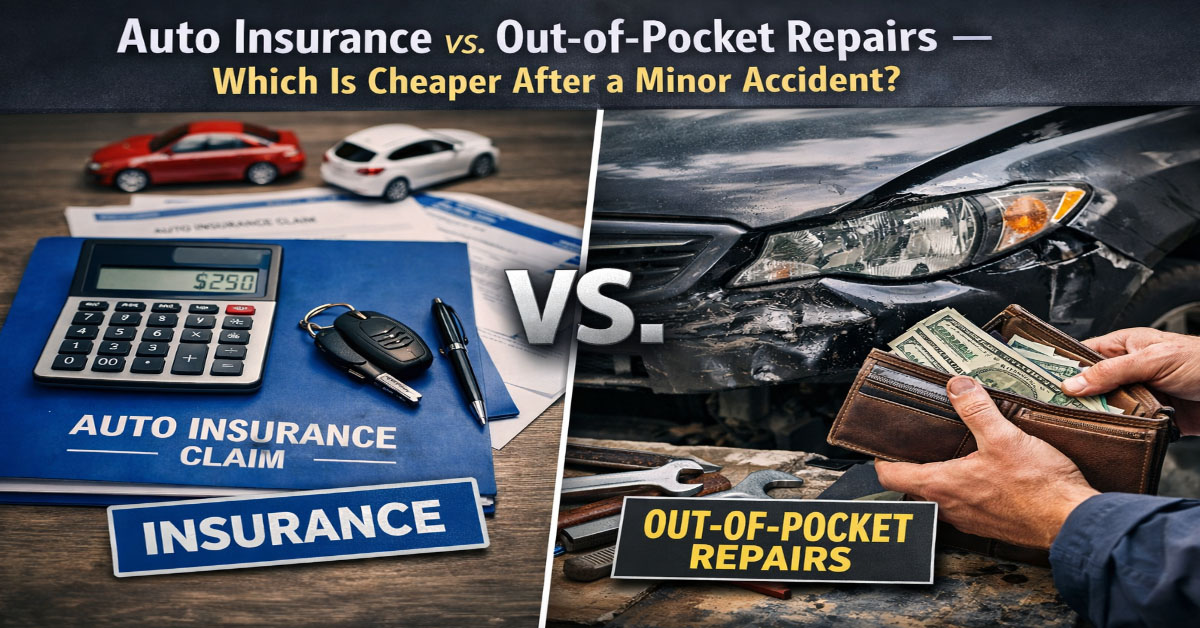
Whether to file an insurance claim or pay for a minor accident repair out of pocket is one of the most consequential and least understood decisions in auto insurance. Most drivers default to filing, reasoning that they pay premiums precisely for these moments. What they often fail to account for is the multi-year rate surcharge that follows an at-fault claim, which can cost far more than the repair the insurance paid. This guide gives you the complete analytical framework to make this decision correctly every time.
In This Article
- How Claims Affect Your Premiums for Years
- Rate Surcharge Data by Claim Type
- The Complete Decision Math: Three Worked Examples
- When You Should Always File a Claim
- When Paying Out of Pocket Is Smarter
- The Third-Party Complication
- Getting an Accurate Repair Estimate
- After You Decide: Documentation and Next Steps
- EV Repair Costs: The Special Case
How Insurance Claims Affect Your Premiums for Years
The premium impact of filing an at-fault auto insurance claim is not a one-time event. Insurers apply a surcharge to your renewal premium that typically persists for three years from the claim date, though the exact duration varies by insurer and state. Some carriers apply surcharges for five years for more serious claims. The surcharge begins at your next renewal after the claim and may diminish before disappearing entirely at the end of the surcharge period.
The mechanism works through a points system, sometimes called chargeable events, depending on the insurer. An at-fault collision claim adds points to your record with the insurer that translate directly into premium surcharges. Multiple claims in a short period compound dramatically and can result in policy non-renewal rather than simply higher rates.
The critical insight is that the rate impact of a claim is not proportional to the claim amount. A $1,200 at-fault collision claim triggers almost identical rate surcharges as a $4,000 at-fault collision claim at most insurers. The claims system does not distinguish between a minor parking lot incident and a meaningful collision in terms of the surcharge structure applied. This means the financial calculus strongly disfavors filing small claims even when the repair exceeds your deductible by a meaningful margin.
Typical Rate Impacts After At-Fault Claims
Rate Surcharge Data by Claim Type
These figures represent averages across major national carriers. Your specific insurer's surcharge schedule can be obtained by calling your agent and asking for their chargeable incident surcharge table. Some carriers are significantly more aggressive than others. Knowing your specific insurer's structure before a claim occurs allows you to make the filing decision with accurate data rather than estimates.
One important nuance: comprehensive claims, which cover events like hail damage, theft, deer strikes, and weather-related damage, are generally not surcharged or are surcharged at much lower rates than collision claims at most major carriers. This is because comprehensive events do not reflect on your driving behavior or risk profile in the same way that at-fault collisions do. The pay-out-of-pocket analysis in this guide applies primarily to at-fault collision claims.
The Complete Decision Math: Three Worked Examples
Example 1: The Classic Parking Lot Dent
You back into a concrete pillar. The damage to your rear bumper and trunk lid is $1,800 to repair. Your collision deductible is $500. Your current annual premium is $2,100. Your insurer's surcharge for an at-fault claim is 35 percent for 3 years.
If you file the claim: You pay $500 deductible. Insurer pays $1,300. Annual premium increase: $2,100 times 35 percent equals $735 per year. Surcharge over 3 years: $2,205. Total cost to you over 3 years: $500 plus $2,205 equals $2,705.
If you pay out of pocket: You pay $1,800. No premium impact. Total cost: $1,800.
Result: Paying out of pocket saves $905 over three years in this scenario despite the insurer technically covering $1,300 of the repair cost when you file.
Example 2: The Not-At-Fault Collision
Another vehicle clips you in traffic. Damage is $4,500. You are not at fault but must use your own collision coverage in your state. Deductible $500. Premium $2,100. Carrier does not surcharge for not-at-fault claims.
If you file the collision claim: You pay $500 deductible. Insurer pays $4,000. No rate impact since carrier does not surcharge not-at-fault claims.
If you pay out of pocket: You pay $4,500.
Result: Filing is clearly correct in this scenario. The insurance payment of $4,000 exceeds your deductible contribution and there is no rate penalty. This is exactly the scenario insurance is designed for.
Example 3: The Borderline Case
Your rear bumper is damaged in a collision that is your fault. Repair estimate: $1,100. Deductible: $500. Annual premium: $1,800. Carrier surcharge: 30 percent for 3 years.
If you file: You pay $500. Insurer pays $600. Annual surcharge: $1,800 times 30 percent equals $540 per year for 3 years equals $1,620 total. Total 3-year cost: $500 plus $1,620 equals $2,120.
If you pay out of pocket: You pay $1,100. Total: $1,100.
Result: Paying out of pocket saves $1,020 over three years despite the insurer covering $600 of the cost when you file. The insurance payout looks attractive in isolation but is economically inferior when the full rate impact is included in the analysis.
When You Should Always File a Claim
Any accident involving injury to another person is a mandatory claim scenario. Personal injury liability can easily exceed $100,000 in medical costs for even moderate injuries. The liability exposure from attempting to handle an injury accident without your insurer's involvement is catastrophic. File immediately, call your insurer before leaving the scene if possible, and do not attempt to negotiate directly with injured parties under any circumstances.
Large repair costs clearly justify filing. A reasonable rule of thumb is that any repair cost exceeding two to three times your deductible in an at-fault scenario, after accounting for the expected rate surcharge at your carrier, warrants filing. At $5,000 or more in damages, the net financial benefit of filing grows even after accounting for a three-year surcharge in most scenarios.
Total loss scenarios, where repair cost approaches or exceeds the vehicle's actual cash value, almost always warrant filing regardless of deductible amount. Losing a $15,000 vehicle to save a premium surcharge is poor math by any calculation. Uninsured motorist claims should generally be filed when the damage is meaningful, particularly at carriers that do not surcharge for uninsured motorist claims.
When Paying Out of Pocket Is Almost Always Smarter
Paying for repairs yourself is strongly favored when the damage amount is moderate, the incident is at-fault, your current deductible is relatively high, and your existing premium is already elevated. The combination of a high deductible reducing the net insurance benefit and a high base premium amplifying the dollar impact of the percentage surcharge creates conditions where filing almost never pencils out for moderate claims.
If you already have a recent at-fault claim on your record within the surcharge window, paying out of pocket for a second incident is particularly important. A second claim while still in the surcharge period from a first claim can trigger policy non-renewal, potentially forcing you into the non-standard market where premiums can be two to three times what you currently pay. Absorbing a $1,500 repair cost yourself to avoid that outcome is almost always the right financial decision.
Cosmetic damage that does not affect vehicle function or safety is another category where out-of-pocket payment or deferred repair makes sense. A scratched bumper that is purely aesthetic does not require immediate repair. Deferring or declining the repair entirely eliminates the claim question altogether.
The Third-Party Complication
The cleanest pay-out-of-pocket scenarios involve damage only to your own vehicle. The calculus becomes more complicated when another vehicle or person is involved.
If you damage another driver's vehicle in a minor, clearly at-fault scenario and both parties agree on a private settlement, the legal and financial framework around that settlement matters significantly. Document the agreement in writing, including a release of further claims, before making any payment. Without a written release, the other party can pursue you through insurance or the courts for additional amounts at any future point, including injury claims that surface later.
Never pay cash and walk away from an accident involving another vehicle without documented evidence that both parties have assessed the damage, agreed on a resolution, and released each other from further claims. The risk of a later, larger claim materializing from a seemingly minor incident is real and can be financially devastating without proper documentation of the original agreement.
If the other party is at all aggressive, mentions injury at the scene, or you have any doubt about the damage scope, file your claim rather than attempting a private settlement. Having your insurer involved, including access to their legal resources if needed, is worth the premium surcharge in uncertain situations.
Getting an Accurate Repair Estimate Before Deciding
Before you can apply the decision framework, you need an accurate repair estimate. Modern vehicle repairs, particularly those involving sensors, cameras, or structural components even on vehicles that appear only superficially damaged, can cost significantly more than a visual assessment suggests. Do not make the filing decision based on a guess or an informal assessment.
Get two to three estimates from reputable body shops. For vehicles with sensors in bumpers or other ADAS components, specifically ask whether the estimate includes camera calibration and sensor replacement if required. Document the damage thoroughly with photos and video before any repair work begins, regardless of how you ultimately handle the payment. This documentation protects you if the repair reveals more extensive damage than initially visible, and it documents the original incident scope if questions arise later.
After You Decide: Documentation and Next Steps
If you decide to pay out of pocket, keep a complete paper trail. File the estimate, document the repair with photos of the completed work, and retain the paid invoice. If you ever face a question about the incident from another party or from your insurer, this documentation establishes what the damage was, what was repaired, when, and at what cost.
If you decide to file a claim, contact your insurer before authorizing any repair work. Most policies require insurer authorization or at minimum notification before covered repairs are completed. Your insurer may have preferred repair shops with negotiated labor rates that can reduce the total claim cost and smooth the process. Filing without notification and then presenting a completed invoice can complicate the claim and potentially reduce the insurer's payment.
EV Repair Costs: The Special Case
Electric vehicle owners face this decision with some important differences. EV repairs are structurally more expensive than equivalent conventional vehicle repairs, which means the damage threshold at which filing becomes financially justified is lower for EV owners.
A minor collision that produces surface damage on an EV requires careful assessment of whether the battery pack or battery-adjacent structural components were affected. Damage that looks cosmetically minor can involve battery compartment structural work costing $8,000 to $15,000 to repair safely. The risk of assuming a minor-looking EV accident is inexpensive without a thorough certified shop assessment is substantially higher than with conventional vehicles.
For EV owners, getting a detailed damage assessment from an EV-certified shop before making the filing decision is particularly important. Do not rely on a visual estimate or a non-certified shop's preliminary assessment for any EV that has been in a collision that reached bumper level or below the floor line. The battery inspection alone requires certified equipment and expertise that most conventional shops cannot provide reliably.
Understanding Your Auto Insurance Declarations Page
Your declarations page, commonly called the dec page, is the single most important document in your auto insurance relationship. It is a one or two page summary of everything your policy covers: the covered vehicles, all named drivers, each coverage type, the limit for that coverage, the deductible, the premium for that coverage, and the total annual premium. Knowing how to read your declarations page is the foundation of any intelligent insurance management decision.
The coverage section lists each coverage type separately: bodily injury liability, property damage liability, medical payments or personal injury protection, uninsured motorist, underinsured motorist, collision, comprehensive, and any endorsements you have added. Each coverage has a premium associated with it. By examining these individually, you can identify which coverages are consuming the largest share of your premium and evaluate whether adjusting them would make sense for your situation.
The limits section shows the maximum the insurer will pay for each coverage category. Bodily injury limits are expressed as a per-person and per-occurrence pair, such as $100,000 per person and $300,000 per occurrence. This means the insurer will pay up to $100,000 for any single injured person and up to $300,000 total for all injured parties from a single accident. Understanding these limits and whether they are adequate for your asset level is one of the most important evaluations you can perform on your current policy.
When you compare quotes from competing carriers, you are comparing their pricing for identical declarations page specifications. Any quote with different limits, deductibles, or coverage inclusions is not a meaningful comparison regardless of how the headline number looks. The discipline of quoting on identical specifications is what separates productive insurance shopping from the experience of switching to a cheaper policy only to discover the coverage gap when a claim occurs.
How Accident Forgiveness Programs Work
Accident forgiveness is an endorsement or program feature offered by many major carriers that waives the premium surcharge for a first at-fault accident within a defined eligibility window. The programs vary significantly between carriers in terms of eligibility requirements, how the forgiveness is earned or purchased, and exactly what is forgiven.
Some carriers include accident forgiveness automatically after three to five years of continuous claim-free coverage with that carrier. Others offer it as a purchasable endorsement add-on. Some programs forgive only the first at-fault accident regardless of severity. Others have damage amount thresholds above which forgiveness does not apply. Understanding the specific terms of your carrier's program before you need it is valuable because the program that sounds like unconditional protection may have conditions that exclude the specific scenario you encounter.
The financial value of accident forgiveness depends on your carrier's standard at-fault surcharge rate and your current premium. If your carrier applies a 35 percent surcharge for three years on a $2,200 annual premium, a single forgiven at-fault accident saves $2,310 in cumulative surcharge costs. The endorsement typically costs $50 to $150 annually. At those numbers, accident forgiveness pays for itself if you have even one at-fault accident during your policy period, making it worth considering particularly for drivers who commute in high-traffic areas or whose household includes younger drivers with statistically higher accident frequencies.
Insurance coverage decisions benefit from regular review because both your circumstances and the insurance market change continuously. Setting a calendar reminder to review your coverage at least 30 days before each renewal gives you time to compare quotes, evaluate coverage changes, and make adjustments based on changes in your financial situation, family structure, or risk exposure. The most effective insurance strategy is not a one-time decision but an ongoing process of alignment between your coverage structure and your actual needs and financial capabilities.