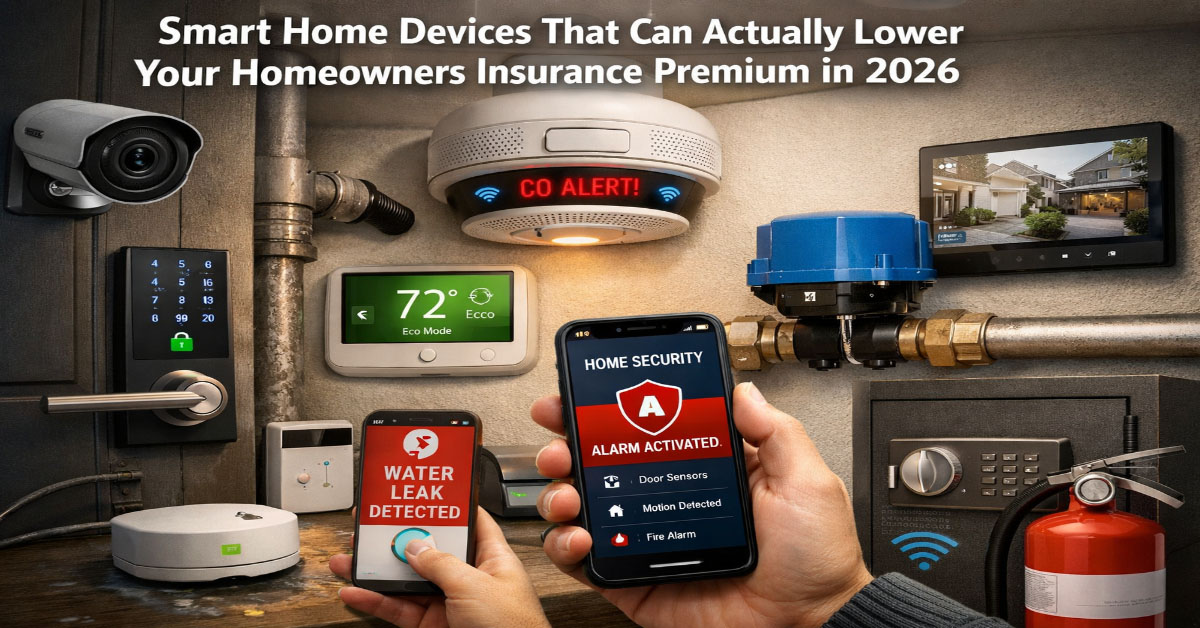
Smart home technology has moved well beyond its novelty phase and into genuine financial utility for homeowners. In 2026, a growing number of home insurance carriers offer explicit premium discounts for homes equipped with connected security systems, water leak detection devices, smart smoke detectors, and other technology that reduces the frequency and severity of insurance claims. The total discount available through combining multiple qualifying devices can reach 10 to 20 percent off your annual premium at carriers with the most robust smart home discount programs.
This guide covers which specific devices actually earn insurance discounts in 2026, how much you can realistically save, which carriers offer the best smart home discount programs, and how to document and claim every discount you qualify for at your next renewal.
In This Article
- Why Insurers Discount Smart Home Devices
- Smart Security Systems
- Water Leak and Shut-Off Devices
- Smart Smoke and Fire Detection
- Other Devices That May Earn Discounts
- Which Carriers Offer the Best Smart Home Programs
- Return on Investment Calculation
- How to Claim Your Discounts
- The Future of Smart Home Insurance Programs
Why Insurers Discount Smart Home Devices
Insurance carriers offer smart home discounts because the data supports a meaningful reduction in claim frequency and severity for homes equipped with qualifying devices. The economic logic is straightforward: if a water leak detection device prevents a slow plumbing leak from growing into a $25,000 flooring and drywall replacement claim, both the homeowner and the insurer benefit financially. The insurer's discount is a rational sharing of the expected claim savings that the device produces in aggregate across many policyholders.
Water damage is the most expensive claims category for most home insurers, representing approximately 23 percent of all home insurance claims by volume and a significantly higher share by dollar value. A single undetected slow leak can cause tens of thousands of dollars in structural and contents damage before it becomes visible. Smart water sensors that detect moisture or abnormal water flow and alert homeowners to investigate immediately prevent a large percentage of these losses from escalating to their full potential cost.
Burglary and theft prevention through monitored security systems reduces theft claims. Smart smoke and carbon monoxide detectors with automatic fire department notification reduce fire damage severity by shortening the response time between ignition and suppression. Each of these device categories provides quantifiable loss reduction data that actuaries use to justify premium discounts.
Smart Security Systems
A professionally monitored home security system with cameras, motion sensors, door and window sensors, and 24/7 central station monitoring is the most widely recognized smart home discount category across carriers. Professional monitoring means that when an alarm is triggered, a monitoring center staff member attempts to contact you and dispatches emergency services if the situation warrants.
The discount for a professionally monitored security system typically ranges from 5 to 20 percent of the premium, with most carriers clustering in the 10 to 15 percent range. Self-monitored systems that send alerts to the homeowner's phone but do not include professional central station monitoring generally qualify for a smaller discount or no discount at some carriers, because the loss reduction benefit is dependent on the homeowner seeing and responding to the alert promptly.
Major smart security platforms including Ring Alarm Pro with professional monitoring, SimpliSafe with professional monitoring, ADT, Vivint, and Brinks Home are recognized by most major carriers. The critical factor for discount eligibility is the professional monitoring subscription, not the specific hardware brand. Confirm with your carrier which monitoring services they accept before purchasing or switching systems specifically for the insurance discount.
Water Leak and Automatic Shut-Off Devices
Water damage prevention technology has emerged as the most financially impactful smart home category from an insurance claims reduction perspective, and the discount programs for these devices are expanding rapidly as carriers accumulate data on their effectiveness. Two categories exist within this space: water sensors that detect moisture and alert the homeowner, and automatic shut-off systems that detect abnormal water flow and immediately close the main water supply valve without requiring homeowner action.
Automatic shut-off systems from companies including Flo by Moen, Phyn, and Leak Defense detect water flow anomalies including slow leaks, running toilets, unusual duration flows, and pipe bursts and automatically shut off the water supply before the damage escalates. These systems provide significantly stronger loss prevention than alert-only sensors because they act even when the homeowner is away, asleep, or unable to respond immediately.
Carriers including Hippo, Openly, Chubb, and Travelers have developed specific discount programs for automatic shut-off devices that range from 5 to 15 percent off the annual premium. Some carriers offer the devices themselves at reduced cost or as a benefit for policyholders. For a homeowner paying $3,000 per year in home insurance, a 10 percent discount from a water shut-off system saves $300 annually. The device itself costs $500 to $700 installed, producing a payback period of less than three years through insurance savings alone before accounting for any actual water damage prevented.
Smart Smoke and Fire Detection
Interconnected smart smoke and carbon monoxide detectors that alert the homeowner's smartphone and can automatically notify the fire department through professional monitoring services qualify for discounts at many carriers. The key insurance advantage over standard standalone smoke detectors is the monitoring and notification capability that reduces fire department response time when a fire occurs while residents are away or asleep.
Nest Protect, First Alert Onelink, and similar systems that integrate with professionally monitored home security platforms earn the security system discount at most carriers when they are included in the monitored system. Standalone smart smoke detectors without professional monitoring integration may qualify for a smaller discount specifically for the interconnected detection benefit.
Standard hardwired smoke detectors in a home, while required by building codes and valuable for safety, typically do not earn specific insurance discounts because their presence is assumed in modern homes. The discount opportunity is specifically for the enhanced notification and monitoring capabilities that smart systems provide beyond basic local alarm functionality.
Other Devices That May Earn Discounts
Several additional smart home device categories are recognized by some carriers for premium discounts. Smart door locks with auto-lock capability and access logs can qualify for security discounts at some carriers as evidence of active home security management. Video doorbells with motion detection and cloud recording qualify for discounts at some carriers as deterrence and documentation tools. Smart thermostats with pipe-freezing alerts that notify homeowners when indoor temperatures approach freezing levels are recognized by some carriers in cold-climate markets as freeze damage prevention tools. Sump pumps with water level sensors and failure alerts qualify for discounts at some carriers in flood-prone markets as flood damage mitigation devices.
Smart Home Insurance Discounts: Typical Range by Device
Which Carriers Offer the Best Smart Home Programs
Hippo Insurance has built its brand specifically around smart home risk management and offers among the most aggressive smart home discount programs in the market. Hippo provides Notion smart home sensors to new policyholders in many states and offers meaningful discounts for homes with comprehensive smart home setups. The company's underwriting model explicitly incorporates smart home risk reduction data into its pricing.
Travelers offers a discount for water shut-off device installation through their partnership with Flo by Moen and has one of the better-documented programs for automatic water shut-off technology specifically. Chubb, which primarily serves high-value homes, has developed sophisticated smart home discount programs that can reach 20 percent for homes with comprehensive monitored systems. Liberty Mutual, State Farm, and GEICO all offer security system discounts in the standard 10 to 15 percent range for professionally monitored systems.
Return on Investment Calculation
Evaluating the investment in smart home devices purely on insurance discount ROI is a useful starting point, though the total benefit includes the actual loss prevention value beyond what insurance covers. For insurance discount ROI specifically: if a professional monitoring subscription costs $360 per year and earns a 15 percent discount on a $3,000 annual premium, the insurance savings are $450 per year. Net annual benefit from insurance savings after monitoring cost is $90 per year. The hardware cost of a monitoring-capable system is typically $300 to $600 for installation, producing a two-to-three year payback on hardware costs even before any actual security or prevention value is counted.
For automatic water shut-off systems, the device and installation cost of $500 to $700 against annual insurance savings of $150 to $300 at eligible carriers produces a two-to-five year payback. Add the value of any actual water damage prevented by the system and the financial case becomes even more compelling. A single prevented pipe burst claim averages $10,000 to $20,000 in repair costs; the probability of a pipe burst over a 10-year homeownership period is not trivial in older homes or cold climates.
How to Claim Your Discounts
Smart home discounts are not always automatically applied by your insurer. You must proactively notify your insurer of qualifying devices and provide documentation that they meet the carrier's program requirements. For professional monitoring discounts, this typically means providing your monitoring company's name, your account number, and confirmation of active monitoring service. Your monitoring company can usually provide an official certificate of monitoring service for this purpose.
For water shut-off devices, carriers typically require the device make and model and confirmation of active connectivity. Some carriers require you to register the device with the carrier's preferred partner program. Contact your insurer directly to understand their specific documentation requirements before purchasing devices specifically for the insurance discount, as requirements vary and some carriers require specific brands or partner programs.
The Future of Smart Home Insurance Programs
The smart home insurance discount market is still developing and will become more sophisticated and financially significant over the next several years as more claims data accumulates and carriers compete for tech-forward homeowners with strong risk profiles. The direction is toward more integrated programs where the insurer provides or subsidizes smart home devices in exchange for risk data access, similar to what telematics programs have done in auto insurance. Usage-based home insurance pricing, where premiums reflect real-time home condition data from connected sensors rather than static underwriting factors, is a near-term possibility that several carriers have publicly discussed as a development objective.
Homeowners who invest in smart home technology now for genuine risk management and convenience purposes will be well-positioned to benefit from these evolving programs as they develop more competitive discount structures and become more broadly available across carriers.
Understanding Your Home Insurance Policy's Coverage Sections
A standard homeowners insurance policy is organized into distinct coverage sections, each addressing a different aspect of your financial exposure. Understanding what each section covers and where the limits apply helps you identify potential gaps and make informed decisions about endorsements or supplemental coverage that might be appropriate for your specific property and circumstances.
Coverage A is dwelling coverage, which pays to repair or rebuild the physical structure of your home if it is damaged by a covered peril. The dwelling coverage limit should reflect the estimated cost to rebuild your home from scratch, not its market value or purchase price. Rebuilding cost and market value can diverge significantly, particularly in markets where land values represent a large portion of property value or where construction costs have risen faster than home prices. An annual review of your dwelling coverage limit against current construction cost estimates helps prevent the co-insurance gap that occurs when your coverage limit falls meaningfully below actual rebuilding cost.
Coverage B is other structures coverage, which pays for damage to structures on your property that are not the main dwelling. Detached garages, fences, pools, sheds, and guest houses are all covered under this section. The limit for other structures is typically set at 10 percent of the dwelling coverage amount by default. If you have substantial outbuildings, a detached garage with valuable equipment, or a standalone structure used for a home business, evaluate whether the default 10 percent limit is adequate for your specific property configuration.
Coverage C is personal property coverage, which pays for damage to or theft of your belongings anywhere in the world. The default coverage limit is typically 50 to 70 percent of the dwelling coverage amount. Personal property coverage operates on either a replacement cost value basis or an actual cash value basis. Replacement cost value coverage pays what it costs to buy a new equivalent item. Actual cash value coverage pays the depreciated value of the lost item, which is often substantially less than what it costs to replace it. Upgrading to replacement cost value for personal property is generally worth the additional premium, particularly for households with significant electronics, furniture, and clothing.
Flood Insurance: The Coverage Gap Most Homeowners Do Not Know They Have
Standard homeowners insurance policies explicitly exclude flood damage. This exclusion is one of the most consequential coverage gaps in American property insurance and affects homeowners in every state, not just those in recognized coastal flood zones. Flooding caused by storm surge, rising rivers, overflowing storm drains, heavy rainfall runoff, and snowmelt can all cause catastrophic home damage that is entirely uninsured under a standard homeowners policy.
Flood insurance is available through the National Flood Insurance Program, administered by FEMA, and through a growing number of private flood insurers who entered the market in recent years. NFIP policies provide coverage for the building structure and its foundation, electrical and plumbing systems, HVAC systems, appliances, and the floor coverings and cabinets considered permanently installed. Personal belongings are covered under a separate NFIP personal property policy that must be purchased independently from the building coverage.
The common misconception is that flood insurance is only relevant for properties in FEMA-designated high-risk Special Flood Hazard Areas. In reality, approximately 25 percent of all NFIP claims come from properties outside the highest-risk flood zones. Properties in moderate-risk areas receive lower NFIP premium rates than high-risk areas, making flood coverage more affordable than many homeowners assume. In a state like Texas, where flash flooding affects neighborhoods far from any recognized floodplain on a nearly annual basis, the absence of flood insurance is a significant and common financial vulnerability.
Insurance coverage decisions benefit from regular review because both your circumstances and the insurance market change continuously. Setting a calendar reminder to review your coverage at least 30 days before each renewal gives you time to compare quotes, evaluate coverage changes, and make adjustments based on changes in your financial situation, family structure, or risk exposure. The most effective insurance strategy is not a one-time decision but an ongoing process of alignment between your coverage structure and your actual needs and financial capabilities.